
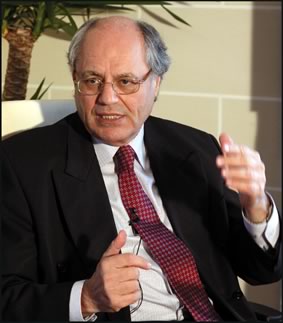
Edward Scicluna and the living wage
 In the run-up to the 1996 elections, we saw Lino Spiteri struggle to accommodate Alfred Sant’s shock announcement – made without consulting his shadow minister of finance – that he would remove value added tax when elected prime minister.
This stuggle ended with Spiteri’s resignation as finance minister around seven months after Labour was elected to government. He could not reconcile himself to the mad contortions required to replace the perfectly serviceable value added tax with a square wheel called CET.
Now I suspect we are about to see the same thing or similar with Edward Scicluna and the living wage.
Scicluna has had an article published in The Times today, called Why the Need of a Living Wage.
Over the first two-thirds of his piece, he gives detailed and clear reasons why the living wage is no longer relevant, having been born as an idea before the welfare state, the market economy and labour unions. He explains how vehemently he argued against it even as far back as 1970 when he was at university, saying that there should be no discrimination among workers according to how many children they have and what their household bills are.
And then, when he has finished listing the forceful arguments against the idea of a living wage, Edward Scicluna takes a deep breath, girds his loins, and asks the question: “So why should one raise the concept of a living wage now?”
And then, in an attempt at convincing us when he is clearly not at all convinced himself, he loses it. He answers his own question by saying:
The naked truth is that never as today have so many families felt themselves slowly but surely sliding down into abject poverty. Many Maltese families are feeling they can no longer live decently with one’s wage and crumbling welfare state system. What has been obtained incrementally over four post-war decades is now unravelling in a matter of a few years.
This is so obviously untrue that it is not even hyperbole. Hyperbole is an exaggeration of the truth. This, on the other hand, is fantasy.
Edward Scicluna, as an economist and a man over 60, must know for a fact, through his research and through the experience of having been an adult since the 1960s, that he would be hard put to find a single Maltese person who does not live more comfortably in every respect than his parents, grandparents and certainly great-grandparents did.
Even those whose families have been privileged for the last three generations live more comfortably today. They may not have the retinues of servants earlier generations were accustomed to, but they certainly have homes and ways of life which are infinitely freer, more varied and pleasant. They might not have maids and butlers but they have more material comforts.
I am a generation younger than Edward Scicluna, but even I have enough perspective to see that what he says about the great slide into abject poverty is utter tosh. The welfare state is not crumbling, but it is the best it has ever been.
People feel they can no longer live decently on their wage because material expectations of what is decent have skyrocketed disproportionately, and this is precisely because our general standard of living is so much higher than that of our parents and grandparents.
Many of those who are grumbling now were born to parents who grew up sleeping on straw in garages or six to a bed in two rooms shared by 20 people. And they say their standard of living has fallen?
Edward Scicluna knows the truth of this, which is why he sounds so very unconvincing and can’t find any arguments in favour of a living wage.
Instead, he comes up with this:
Poverty is becoming a real threat. Their wage is definitely not delivering what they consider decent living. Definitely they yearn for a living wage.
Yearn? And I yearn to lie around on the sofa all day for the next five months, reading books and doing not much else. Well, tough. Since when is sound economic policy based on who yearns for what?
The interesting thing is that Scicluna fails to mention one way these moaning families can get themselves a living wage without becoming a burden on anyone else: persuading mother to let go of the pine disinfectant bottle and floor-cloth and head off into the workplace. Bingo! Overnight, you have two wages coming in.
The Malta Labour Party must be the only socialist party in Europe to have a right-wing, conservative approach to working mothers. It’s embarrassing.
88 Comments Comment
Leave a Comment
A living wage ignores the fundamental and basic concept that you should always adapt your lifestyle according to your wage/salary and not expect your wage/salary to adapt to your lifestyle.
The problem is that people try to live beyond their means and expect everything for free. Unfortunately the Labour Party encourages people to think this way. I don’t even know why they are called Labour if they don’t encourage people to work.
This is the worst economic idea since the VAT/CET mess.
I believe he is passé as most of his theories are based on the defunct Marxist philosophy wrapped in nice terminology to justify the end he has in mind.
I think you are over-estimating Scicluna. There’s no left, right or new politics with Scicluna. His politics extend to the tip of his pockets. Reporting on election results has been his best feat to date. His peak was when he helped sell Mid Med Bank for a bag of peanuts and a pinch of salt. Given that he is now retired (as an MEP) one cannot expect more from this guru.
Why didn’t you speak up when he stood for election? Circle-jerk ta’ laghqa.
Careful with the language, Baxxter, There are people on this site who know what circle-jerk really means: the sort of event to which a certain magistrate might be delighted to receive an invitation, with her as the star at the centre of the circle, and at least two of Kevin’s brothers-in-law actually in it.
Kev, you have to declare that you have a conflict of interest when you speak about Prof. Scicluna.
Why – because he pipped Mrs Kev to the post as an MEP?
Yes. In fact, Kev’s comments about Prof. Scicluna taste of sour grapes.
But not the last election result, kev!
“Edward Scicluna, as an economist and a man over 60, must know for a fact, through his research and through the experience of having been an adult since the 1960s, that he would be hard put to find a single Maltese person who does not live more comfortably in every respect than his parents, grandparents and certainly great-grandparents did. This is so obviously untrue that it is not even hyperbole. Hyperbole is an exaggeration of the truth. This, on the other hand, is fantasy.”
Go tell your argument above to today’s average couple living off a yearly income of 30,000 EUR gross, with an eternal mortgage of 150,000 EUR, not to mention the utility bills or the cost of food.
[Daphne – You prove my point. Why in God’s name do two people with a gross income of EUR30,000 have a mortage of EUR150,000?]
You and others may be living more comfortably than your parents, but that doesn’t, by default, make the rest of us in the same situation.
[Daphne – No. EVERYBODY in Malta now lives more comfortably than their parents did. I’m 46, not 66, but even I remember people who lived in houses with no bathrooms, cramped, shared bedrooms and no clothes except one pair of jeans and a couple of shirts. I even remember people sleeping on roll-outs on the floor, or hay bales. Something tells me you missed all that and somehow believe that life was always like it is today.]
Disposable income = income less taxes and fixed costs (e.g. rent/mortgage, food, car, payments, insurance, etc).
How could one consider himself more comfortable, today, if the fixed costs have sextupled in the past 20 years whilst average income has, at best, only doubled? The previous generations’ level of wealth was clearly higher than today’s. How could you, otherwise, explain the fact that so many people in the old days owned a house and/or a piece of land without owing a dime to anyone?
[Daphne – You are so incredibly ill-informed. Do you actually think that people owned even one car per family, let alone three or four? Do you think they took loans and bought their own house? Most of my friends lived in houses which their parents rented for peanuts a year as sitting tenants – and we were the tal-pepe. They had one car per family, if that. Most of our mothers didn’t drive and if they did have a licence, it was pointless because the family car went with the father to work and there wasn’t another one. Then at the weekend there would be fights and chaos as everyone in the family tried to borrow the same single car. Clothes? Two pairs of jeans, one to wash and the other to wear. Almost nobody took holidays abroad, let alone family holidays. I’m talking about the tal-pepe here, not the working class. The working class was so deprived that I can’t even begin to describe to you the ignorance of even the most basic material things and foodstuffs. You talk about ‘previous generations’ level of wealth’ like somebody who has just worked it out on paper. Well, you’re talking to somebody who was actually around to see it. I cannot believe your naiviete when you say that ‘so many people in the old days owned a house and/or a piece of land without owing a dime to anyone’. Who owned a house and land? The minority, that’s who. Everyone else rented and the rest crammed themselves 20 to a room in tenements or lived with their parents when they married. Houses were dirt cheap – a couple of thousand liri could buy you one – and still people couldn’t afford to buy them (which is why they were cheap, because demand was so low). That alone should tell you a lot about how well off people were.]
If it wasn’t for this country’s sizeable underground economy, yes, we would have our own fair share of homeless people and beggars in the street.
[Daphne – Grow up. I mean it, really.]
There are none so blind as those who will not see.
Honestly, Daphne, I wonder why you waste your time answering people who are aware of how much better off we are now but refuse to admit it because they are ‘lejboristi’. Give them a couple of years and should they, God forbid, have their party in government the tune will change dramatically.
Haven’t we been here before? I distinctly remember lejborist in some other debate months ago arguing in this fashion.
It’s incredible how dangerously misinformed some people are. I bet il-lejborist grew up in a nice little villa somewhere shielded from pretty much everything, constantly being told how much worse off we have it in Malta than pretty much anywhere else (except for Libya, of course, and maybe even North Korea).
And I bet, Coward, you’re another self employed, comfortably living off his undeclared income, and who has been sold the illusion that Malta’s standard of living is second to no other country’s. Dude, you need to watch less NET tv and go out more.
[Daphne – You haven’t told us whether he was right about you, though. Well, is he? I rather suspect that he is.]
Actually, I live off a miserly wage in another European country… in other words, I am subjected to neither Net nor One!
“Go tell your argument above to today’s average couple living off a yearly income of 30,000 EUR gross, with an eternal mortgage of 150,000 EUR”
Can you tell me which bank would give such a home loan?
They all do, especially if you threaten them of getting the loan from elsewhere. After all, it’s not that there’s any particular risk to the banks.
[Daphne – Where’s the nearest wall, so that I might hit my head against it? Lejborist, read these points carefully. 1. There is considerable risk to banks in lending money to those who can’t afford to pay it back, even if the loan is secured against the property it was used to buy. 2. When homes are repossessed because their owners have defaulted on loan repayments, they tend to be sold at less than the money lent to buy them because banks are in the business of money not property and cannot hang on to repossessed real estate until the market is buoyant again. 3. Do you know how the US financial crisis started, triggering meltdown in the rest of the world over the last two years? That’s right: banks irresponsibly giving home-loans to people who couldn’t afford them. Like I said, grow up and stop repeating your parents’ kvetching in the kitchen.]
And do you have any idea what hoops banks have to jump through to reposess a home in Malta especially if it’s the defaulter’s only residence?
“They all do, especially if you threaten them of getting the loan from elsewhere. After all, it’s not that there’s any particular risk to the banks.”
Don’t invent! They know that other Maltese banks will turn you down too! It’s one of the reasons Maltese banks were voted in the top 10 most sound banks in the world!
The most you can do is negotiate the interest rate, and bully for you!
The max you can get from banks in Malta for a house loan, by rule of thumb, is three times annual income.
Annual income Euro30,000 – Mortgage Euro150,000: Sub-prime mortgage anyone?
The point is that first-time buyers want to reach the top of the property ladder when they buy their first property, instead of buying what they can really afford and then trading up when their income/s increase. It’s all about keeping up with the Joneses, wanting everything yesterday and getting priorities wrong, such as a mega-galactic wedding reception to make the neighbours/relatives green with envy.
Not true. Check HSBC’s online calculator. On a gross monthly salary of €2500 I could borrow €120,000, with up to €172,000 in special cases.
If I remember correctly it’s 3.5 times your annual income for a couple, or four times the annual income for a single person.
Exactly Pat, 30000 * 3.5 = 105,000 and not 150,000 – 45,000 is quite a difference, to me at least but then again I don’t earn 45,000 a year like lejborist says he does.
“[Daphne – Why in God’s name do two people with a gross income of EUR30,000 have a mortage of EUR150,000?”
And what (in God’s name) could you possibly buy with less than 150k, a straw shack in the middle of Bormla?
[Daphne – Quite a lot, actually. You can get something pretty decent for EUR90,000, but that depends on whether you think a couple’s first home should be their last. And what’s wrong with Bormla – or do you think people have a Godgiven right to live in Madliena even when they don’t have the money? If all you can afford is a flat in Bormla, then that’s where you’ve got to buy. Then if you don’t like it, you work harder, earn more money and buy something bigger somewhere else. ou sound like a spoiled brat to me.]
And, yes, it is mainly the beneficiaries of our underground economy who are surely better off as opposed to the previous generations and not those on an average salary.
[Daphne – What’s this nervous tic you have about ‘previous generations’? Do you come from a long line of feudal barons who suffered a ‘Gattopardo’? Because if you don’t, then my bet is on you being a whole lot better off than your parents and grandparents were, whatever they might have told you. Instead of listening to them, ask questions and find out how they actually lived, where, in what sort of house, what they had in it, how often they travelled and what they spent on fun and clothes. Then you’ll see. Oh, and if you think we have a thriving underground economy now (and you’re right about this), you should have been around in the days when most of the economy was underground because of the 95% tax rate in the top income band, and no tracking system through VAT.]
If, like many lawyers, doctors, masons, tile layers and building contractors on this blessed rock, I had the option to be a tad creative and self assess my own income and tax, admittedly, I would be perfectly in agreement with your theory but unfortunately I do not fall under that category.
[Daphne – Oh really? Then why are you sitting around complaining instead of retraining as a tile-layer? What’s stopping you becoming a tile-layer? Too full of yourself to become a skilled tradesman, are you? You’d rather sit around whining about the inadequacy of your salary as long as you sit behind a desk than earn more and lay tiles? God, no wonder you vote Labour. You sound really mittilkless to me: too scared to lay tiles in case somebody looks down on you.]
You can get perfectly good 2 bedroom flats in Sliema for 70 – 100k Eur.
Have a look at the classifieds lejborist.
[Daphne – Ah, but they’re not good enough for him. He wants a large house with space for a pool.]
“Quite a lot, actually. You can get something pretty decent for EUR90,000”
I think youre confusing euros with liri.
[Daphne – No, I’m not. Pick up the classified section of The Sunday Times or one of the several real estate supplements that come free with the newspapers (do you read newspapers, incidentally?) and you’ll see.]
“And what’s wrong with Bormla?”
Don’t be unfair, I didn’t say there was anything wrong with Bormla. I mentioned Bormla because it’s the town with the cheapest property on the island.
[Daphne – It isn’t.]
“Then why are you sitting around complaining instead of retraining as a tile-layer? What’s stopping you becoming a tile-layer? Too full of yourself to become a skilled tradesman, are you? You’d rather sit around whining about the inadequacy of your salary as long as you sit behind a desk than earn more and lay tiles? God, no wonder you vote Labour. You sound really mittilkless to me: too scared to lay tiles in case somebody looks down on you.”
I have 2 degrees, an MBA, a salary of 45K and a ordinary house in the south which i bought (with no help from anyone, except the bank’s of course) for 230,000 so i don’t really need to retrain myself, and I am not complaining about my situation either. But i know many whose state of affairs is a tad different from mine.
[Daphne – Why am I not surprised. And did your grandparents also have two degrees, an MBA, the equivalent of a salary of EUR45,000 a year and a house which they bought for the equivalent of EUR230,000? Or were they illiterate and sharing a bed with eight of their siblings? Just asking. If you know many whose lot is different to yours, then I have news for you: it’s because we’re not living under communism. And the way communism works, it’s not everybody in houses like yours and with salaries like yours, but everybody on a minimum wage in two-roomed flats.]
If you honestly think that there are only a handful of people out there, who, despite doing their utmost, still cannot make ends meet or, at least live a decent life, you should leave your Villa in Bahrija and join Coward for a walk around the island very once in a while.
[Daphne – I don’t live in Bahrija. And I have been getting around the island for rather a long time, which is how I know how people have lived, variously, over the last 40 years. And why I am not shocked because families struggle to make ends meet: because I know that it was ever thus.]
That’s exactly it Daphne, people’s expectations are not commensurate to their earnings.
When I bought my first property, I was bargain hunting for a small 2 bedroom flat and ended up buying one in a not so fashionable area even though the bank would have lent me enough to buy one in Madliena or Swieqi. I did not want to stop enjoying life just because I bought a property.
On the other hand I see many lower income earners buying a first property which is a 3 bedroom maisonette in a very good area of Attard and spending lavishly on filling it up. No wonder they then grumble that they do not have enough disposable income.
This is symptomatic of the malaise afflicting this country. We want a Swedish style social welfare without the taxes, discipline and female participation in the workforce of this country.
Sorry lejborist but you should have been wiser, especially knowing that you have an MBA. A 230K loan on a 45K salary is insane. That must be eating away a third of your net salary unless of course you have a partner earning another 45K.
If you would have considered a decent 3-bedroom maisonette in the south for around 130 – 140K than you would be in a better finical situation, only investing ~ 6 K of your yearly income on loan repayment which would have left you with over a 25K in your pocket. With that sort of money you can live a very decent life in Malta.
Do tell us which bank was so irresponsible in giving you a 230K loan on that salary because mine gave me 150K for a similar income.
…and people lived more comfortably last century than in the one preceding it, Daphne. So? What have you discovered here? That Eddie invented PCs and mobile phones?
It must be a suffocating experience living in such a tiny box.
[Daphne – Skoprejt l-Amerka, Kevin? You sound like a 1930s immigrant who left 20-to-a-room life in Malta for a Brooklyn tenement and comes back after 30 years to patronise everyone. You had to follow your wife to Brussels to get – late in life – the sort of life I always took for granted. So go and patronise your chavvy in-laws. You’re wasting your time with me.]
Wrong again. The tiny box is not about tiny Malta. It’s about your worldview. But you might as well delete this comment, just as you did to my reply to Baxxter. Have fun. Box cutters are going cheaply these days, by the way.
[Daphne – I deleted your reply to Baxxter because if the two of you wish to taunt each other, then you can take it outside. Nobody else is interested. Yes, I know you meant my worldview, and that’s why I wrote what I did: that you and Sharon have the worldview of a couple of chavs ‘li siefru biex isiru nies’. ]
See what I mean? These days you don’t even need to travel abroad to prop up your worldview. But you still think in terms of ‘siefru biex saru nies’ as in Ulied in-Nanna Venut.
With a yearly income of 30000 Euros, younger than 30 years, with a monthly commitment of 500 Euro and a loan repayment term of 25 years, you could only get around 66000 Euro – far cry from your 150000, which by the way is the maximum home loan that one can get.
lejborist – so you have two degrees and an MBA and you manage to earn a salary of 45K. That tells me that you’re an intellectual of sorts.
Have you ever asked yourself how much you, with your intellect, would be worth in the current labour market if you could apply some intelligence in your arguments?
Earth to Snoopy! In which planet are you? The mortgage I was mentioning has a term of 40 years, and so is the term of my mortgage.
A 25-year term is normally given to borrowers over 40 or assigned to loans which are required for house finishing and refurbishment purposes. Now, in a 40-year scenario the monthly commitment would still be in the region of 500/550 EUR a month, hence making the loan acceptable by the bank.
Lejborist
You got a 40 year term – well done.
Now let’s see, a Maltese bank will only grant a mortgage until you are 65 years old, therefore you must have taken it when you were 25.
So, assuming you started university at 18, you got two degrees AND an MBA in 6 years – possible though unlikely.
[Daphne – It’s more than possible. One of my sons got three degrees in five years and I say that because I love rattling the monkeys’ cages.]It also means you were employed as a ‘banker’ with a salary of 45,000 euros at 24 (banks tend not to give mortgages to people on probation – normally a year for a banker).
What’s more, you were employed with this salary fresh out of university!
Wow, you’re good!
I KNOW it’s possible, my wife did it too – as I said, possible but unlikely.
However, getting a salary of 45,000 from a Maltese bank, fresh out of university is – well – even more unlikely.
[Daphne – Yes, particularly with somebody who ‘does mistakes’. Miaaaooowwwww.]
‘Their wage is definitely not delivering what they consider decent living.’
Some people ‘consider decent living’ as having all that they ‘yearn’ for. So is a future PL government going to satisfy all that we yearn for?
To get a crystal clear idea of how indecisive he is, watch this video:
http://www.edwardscicluna.com/?articles/2010/10/…living-wage... – Cached
Website does not exist anymore.
Try edwardscicluna on YouTube
It’s reasonable to urge those who wish to better their lot to “head off into the workplace.” Yet I wonder how many productive new jobs the Maltese economy can actually provide. It wouldn’t be good enough for people to just take in each other’s washing.
[Daphne – It’s a virtuous cycle: the more people work, the more demand they create through their increased income, and the more jobs there are. The demand for furniture, home furnishings and clothes over the last 15 years has escalated precisely because young women, unlike their mothers, continue to work after marriage.]
There are some kinds of poverty which are self-inflicted through poor money-management and living beyond one’s means.
Then there are skewed priorities, like the woman complaining on televison the other day that she couldn’t afford to pay her electricity bill, and that she can’t use the three airconditioners she has had installed.
Then there’s the growing problem of gamblling machines. Most of those who are addicted to them are middle-aged and elderly women. The solution to their problem is not a living wage for their husband, as the spare cash will go down the same route.
You are 100% right in your reply to ‘il-lejborist’. I have a feeling he is a young chap who does not remember at all the days of old. I well remember the days of real poverty as I am of Edward Scicluna’s generation.
Fortunately, we were what one could call ‘middle class’ at the time but we still worked hard to earn a decent living. One has to be really blind or deaf not to see the great leap forward Malta has made in 30 years or so. I also agree that having a mortgage of Euro 150,000 on an income of Euro 30,00 is crazy.
That is what couples are now accustomed to starting off with in marriage – a large house, huge mortgage and all the amenities there and then.
We were brought up to buy what we could afford and no more. We were not pampered and we worked hard for our living not expecting anything for free.
The problem with this country is that people have reached a certain standard of living which they will not relinquish and at the same time are not prepared to work to keep.
We should grow up and see what our real priorities are before grumbling about not being able to live on what we earn. One has just got to live within one’s means and that is it.
Your rhetoric about the working class expresses your bias against the blue and white collared employees. You have evidently expressed it when you attempted to pinpoint the difference between a wage and a salary. Apart from these citizens, who are the majority of the electorate, the middle class is feeling the hardship to make both ends meet. This is the main concern which prevails amongst the majority of voters who will determine the next election. The writing is on the wall.
[Daphne – Blue and white collars! Honestly, what outdated rhetoric. Listen clearly, because you lot live in fairyland: AT NO POINT IN THE HISTORY OF THE WORLD HAS ANYONE BUT THE SUPER-RICH NOT HAD TO WORRY EVERY DAY ABOUT MONEY, NOT HAD TO BUDGET, NOT HAD TO WORK THINGS OUT TO MAKE ENDS MEET AND NOT HAD TO GO WITHOUT X SO AS TO BUY Y INSTEAD. That’s life. Every time our standard of living improves and we find ourselves with more money to spend, we get accustomed to spending it and the next thing we know, it’s no longer enough and we’re having trouble making ends meet. It’s human nature. If you got rid of your car, almost all your clothes and furniture, your computer and your internet connection, your television, took no holidays, rationed your food purchases severely, never went out to a restaurant except at Christmas or Easter or for a special treat on your birthday, and lived without airconditioning in summer and heating in winter, you would have no problem at all making ends meet. But then you’d be living as almost everyone did 25 years ago – and in a house owned by somebody else, too.]
You’re forgetting fancy nails and souped-up cars. Expensive items almost exclusively enjoyed by the lower classes.
How right you are Daphne.
I am not much younger than Edward Scicluna and I know for a fact that life was exactly like you described it in your reply to H Mizzi. No cars, a black and white TV the size of a chest of drawers with a grand total of 2 channels, holidays were something you fantasize about, you didn’t need much furniture because your house was the size of garden shed and you shared your fan with eight other sweaty souls in summer.
That’s not to mention a diet of mostly bread and soup in the hope that on Sunday you might get a treat.
Last week someone reported that there are more than 300,000 vehicles on the island, more mobile phones than the whole population and that there is a far larger percentage of property owners than tenants. Poverty indeed.
As you repeat time and time again, more women must retrain and go out looking for jobs. Nobody owes you a living.
One of my neighbours is always complaining that she can’t make ends meet because life has become sooooo expensive. Kif irrovinana Gonzi! What with the water and electricity bills, the price increase of LPG and fuel, etc, etc.
Poor woman. I almost took pity on her, until I discovered lately that her daughter goes to tennis and swimming classes, her son goes to drama and art lessons, she smokes a packet of cigarettes daily, meets up with her friends for coffee twice or three times a week, owns two cars and goes on an annual family holiday abroad. Her husband is the only breadwinner.
When I suggested that she should try to get herself a job, her quick reply was “Hallini, jekk m’ghandiex, qeghda paxxuta tant, ma jikkmandani hadd”.
I hope her husband gets his living wage, miskina. She yearns to have a summer house, to upgrade her car and possibly take a second holiday.
I agree 100% with Etil. Probably she lived my times. Have nothing against the so called “tal-pepe”. Am not one, but have in-laws who were born and bred in Sliema, and they are adorable.
However, I do not agree that “tal-pepe” had it better and lived more comfortably or what have you. I come from the south, my father was not rich or well off, but we three children lived quite a comfortable lfe, attended private schools for some time, and never wanted for anything. And my mama never worked.
Ok, we lived in a rented house, we had no car as my father didn’t drive, and we only went abroad once…to Sicily as my mama’s sister lived there.
Mama was also a good seamstress (as much as she hated it), and she used to sew day and night to clothe us in the best possible manner.
I remember my papa doing three part-time jobs besides his 9-to-5 one, to bring some extra money home. And he never expected anything from anyone. He worked hard for what he earned.
It was all thanks to both my parents` sacrifices and love that we kids had the best possible childhood ever. Those days people
had priorities: children almost always came first. A good education, well fed, well clothed and a happy home.
These days, it`s the villas, the swimming pools, the flash cars, the cruises, designer clothes, and the social status, whether you can afford them or not. They don`t live within their means, a reason for most unhappy homes.
You just cannot have peace of mind when you know that you would have to work well into old age just to pay mortgages, etc. And all this when, nowadays, both parents work.
I might agree that we have a better standard of living compared to the 60s and 70s, but, my, what a very hefty price we have had to pay!
The families of today do not have butlers and servants because the conditions of service and salaries expected by these people have soared with the general improvement in the standard of living and job opportunities.
In my opinion anyone who says that standards of living in Malta are falling is just making a general nuisance of himself.
There are various reasons for this behaviour.
Primarily, however, the reason is that dyed-in-the-wool PL supporters are unable to countenance the well-being of their Maltese brothers and sisters. They are actually angry about it.
It may seem strange. This is how it has always been though and it will not change.
For them standard of living equates to party in power.
They still yearn for the seventies and eighties and the then living standards. They feign retrograde amnesia.
Pathological but true.
It seems so complicated: http://www.livingwage.geog.psu.edu/places/1603150230
If I was an employer and the living wage becomes legal I would think a dozen times before I employ a semi-destitute employee.
Exactly. The only effect the living wage will have should it be (hopefully not) introduced, is longer recruitment process whilst employers look into potential employees past, family history, spending record etc to then decide whether he should be employed or not irrespective if he is qualified or not for the job.
In the case of prospective female employees, add propensity to becoming pregnant if one factors in paid pregnancy/paternity leave.
Ergajna bil-Bahrija. B-I-D-N-I-J-A. Hemm toqghod din. Bniela il-VILLA Hugh Hefner. Bhala kumpliment. Lejburist, ninsab certa li sijja Daphne u kemm zewgha hadmu u ghadhom jahdmu biex ghandhom dik id-dar, ghax bi tlett itfal mhux facli ta. Imma ma jeqirdux bhal hafna nies.
Dik il-problema hawn Malta – kulhadd jiprettendi kollox jaqa` mis-sema, jew b`xejn, minghand il-gvern insomma. U mela ma hawnx djar jew flats b’ irhas, u MHUX Bormla biss.
Imma daz-zmien kulhadd jrid jibda bil-kbir. Impossibli meta tkun ghadek tizzewweg, u jkunu ghadhom jridu jigu it-tfal. Jaraw wisq kbir, u, jahassra, huma jbatu. Heqq, jekk ghandek OK, imma jekk m`ghandekx ma tistax taghmel passi ikbar milli tiflah. Dak kollu.
Madoffi kultant jiena u Pat nahsbu l-istess haga.
Hekk kont qeghdha nahseb waqt li kont qed nara l-kummenti ta’ qabel. Kulhadd jippretendi kollox mill-gvern u li l-gvern ghandu jidhol ghall-kull diffikulta’ li jkollha il-familja.
Jiena nahseb li fil-passat mhux veru li gew mghallma certu valuri lill-Maltin. Kulhadd kien jara kif ser jisloh lir-regina, per esempju. Insemmu s-servizzi, HMS Dockyard u sejrin. Qisu dak mhux serq, ghax ir-regina. Imbaghad inqalbet il-folja u min jista jisloh il-gvern minflok lir-regina.
Kulhadd igorr u hadd ma jara verament x’inhu jiehu minn ghand il-gvern. Imma ghax irridu kollox mill-gvern, dan ma jaghti xejn jghidu xi whud.
Jekk jista jkun sa l-inqas check up certu nies jippretendu b’xejn. Imma mbaghad ma jimpurtax jekk per ezempju jkollna okkazjoni u mmorru nixtru l-ghola libsa li jkun hemm fil-hanut.
I know Maltese people in the professions who are also millionaires and who built their home on land which was given to them by the state when the Labour Party was in power.
Once the land was given for free the sacrifice they made was to built and furnish the house. But the main source which is the land was given for free.
If Mrs Caruana Galizia and her family live in a house in the wonderful place of Bidnija is thanks to her and her husband’s abilities and efforts. I don’t think the land was given to her for free from the government as the lucky guys I’ve just mentioned.
Yes some of the Pembroke plots handed out pre-1987 for free or about LM 500 a plot were large enough for a swimming pool, room for a pony and throw in a Mercedes as well.
Then imsieken they had to build a villa proportionate to the size of the plot.
Trid taqta il-glekk skond id-drapp li ghandek.
Below is an article on the BBC about EU austerity cuts. We should compare with our situation here.
http://www.bbc.co.uk/news/10162176
Jien nahseb li hawn certi nies ibaghtu bid-dementia. Jien niftakar tfal meta kont l-iskola u jqattaw il-qalziet kienu jaghmlulhom roqa u jibqghu bih.
Biex nilaghbu l-football kien ikolna papocc tac-Cina tas-seba’ xelini u nofs tas seba’ tappijiet konna nghidulhom.
Hafna nies biex jinhaslu kienu jsahnu l-ilma fuq l-ispiritiera tal-pitrolju u jinhaslu go banju taz-zingu.
Johorgu bil-karrozza darba fil-gimgha u meta jigu f’xi nizla jitfulha ‘free’ biex jifrankaw il-petrol. Ir-roti ma kinux jintuzaw ghall-ezercizzju izda ghax ma kontx taffordja tixtri mutur ahseb u ara karrozza.
Fejn tmur tiekol barra? Anqas nafu x’kienet tfisser. Il-Maltin anqas kienu biss iharsu lejn il-lukandi ahseb u ara kemm imorru weekend break.
Fejn kont tixtri karrozza ta’ tmintax? Fejn tmur tiehu drink kuljum wara x-xoghol?
Nies imorru l-bahar bil-picnic cooler bil-hobz biz-zejt jew bil-corned beef, ghax ma kinux jaffordjaw jixtru minn barra.
Kotba tal-iskola tissellifhom! Id-djar kienu bil-lampi tal-pitrolju biex jifrankaw id-dawl. Dak iz-zmien bhal llum? Jew il-lejborist ma jiftakariex din il-hajja? Kemm ghandek ragun, Daphne.
[Daphne – You’ve painted the perfect picture of life as I remember it. Many Maltese didn’t know how to swim for the simple reason that going to the beach was not part of life: they had no car to get there, no swimsuit to wear and it was just a waste of time that could be spent cooking or cleaning. When our parents took us to Ghajn Tuffieha (the large bay next to the hotel, and not the smaller one, which was then reserved for the use of the British military) we would be almost on our own. Childhood photos taken there show me and my sisters playing in splendid isolation on a vast and empty beach, with perhaps one other family in the distance. Occasionally, a village family might take a rare Sunday trip to the beach. They were creatures of wonder to me because the girls swam in their clothes and the boys swam in old jeans that had been cut off at the knees. The parents sat there fully dressed, because they were unable to swim and didn’t have beach clothes or swimsuits. The children couldn’t swim either, because even though they seemed quite large to me (and like all children who grew up by the sea I could swim from the age of four) they wouldn’t venture into the water without clinging for dear life to enormous black rubber rings which I was told were the inner tubes of lorry-tyres. They didn’t buy Miranda or Hi-Spot from the hotel coffee shop (as they would do now, soft drinks having become the preserve of the underclass) but drank water straight out of a jerry-can. These impressions are firmly fixed in my memory.]
Lejborist, let us assume your back-of-envelope arguments are correct. Are you suggesting that under Joe Muscat we will have more disposable income or are you just lamenting the loss of the halcyon days when everyone could afford to buy everything? Or are you just sticking up for ‘the lower class’, to use your terminology?
Good question. No government will ever solve this disposable income problem unless they effectively tackle tax evasion. There is a lot of income generated in this country which is being lost in a black hole.
If, throughout the years, the previous governments had gone guns blazing against the many who have been dodging our tax system for decades, we wouldn’t even know what a government deficit is let alone have it, as the disposable income of the government itself would be much higher than it is today and, consequently, so would be ours.
[Daphne – Errrr, is that why the Labour government taxed all income above a fairly low threshold (can somebody out there remember what it was?) at 95%? And is that why Alfred Sant and his Labour Party fought so violently against value added tax? I’m not going to explain how these are relevant in the fight against the black economy. Your MBA should have taught you that – if not your economics O-level.]
As much as I agree with Daphne when she states that the situation for various households is dire because they themselves have been unnecessarily living beyond their means and, possibly, off a single wage, I do think that, even more so than the voluntarily unemployed, the real cancer are the tax evaders.
[Daphne – How so? Tax evasion and people unable to pay their bills because their expectations are too high are two separate issues.]
As for Muscat and whether he’ll improve this situation, I honestly don’t know. He says that he will seriously fight against corruption and I believe him. Just like tax evasion, corruption is also milking the economy dry so if he really does what he is promising, the situation can surely improve.
“[Daphne – Errrr, is that why the Labour government taxed all income above a fairly low threshold (can somebody out there remember what it was?) at 95%? And is that why Alfred Sant and his Labour Party fought so violently against value added tax? I’m not going to explain how these are relevant in the fight against the black economy. Your MBA should have taught you that – if not your economics O-level.]”
Errrrrrrrr, that’s why I said ‘previous governments’ and not nationalist governments. Read properly.
“[Daphne – How so? Tax evasion and people unable to pay their bills because their expectations are too high are two separate issues.]”
Did Labour also deprive you from taking economics classes back in the day? It’s either that or you were dozing in class when they taught you that tax evasion means less government revenue and less government revenue leads to higher taxes and higher taxes unavoidably lead to people being unhappy about it.
[Daphne – Oh my, how convoluted. So people can’t make ends meet because of the black economy. And not because 65% of women of working age don’t work, meaning that their families can’t make ends meet because they’re surviving on one income, and the rest of us are taxed more to make up for the tax that those 65% don’t pay because they’re not earning. Oh, but I forget, Labour is right-wing conservative: post il-mara huwa d-dar.]
Nobody would disagree with lejborist that there is still a lot of tax evasion going on but equally the government is collecting more tax now than ever before.
I distinctly remember a very successful hotelier and restaurant-owner claiming to earn half of my income as an employee and that was during a Labour administration.
Why should I believe that Joseph Muscat would wave a magic wand and tax evaders fall in line pronto?
It is naive to say the least.
As far as corruption is concerned there’s nothing stopping lejborist or anyone else for that matter to report to the highest authorities. That Joseph Muscat will eradicate all corruption when the Labour Party has a history of harbouring the most corrupt individuals on the island, perhaps we’ll put that one down to fantasy.
I actually think that if Labour had to be elected to govern, corruption will be rampant as the underclass, long starved of power, will be primed and ready to have a go.
Lejborist, you say you believe that Muscat will seriously fight corruption and tax evasion – I beg to differ.
First of all, I do not think that there is any human administration which can eradicate corruption or wants to fight “beyond a certain” level tax evasion.
Speaking about corruption in Malta, we need to distinguish between what I call institutional corruption (the alleged case involving BSWC) and corruption at the level of the commoner which was the bread and butter of the previous MLP administration – you cannot equate these. Whilst the former happens at the high echelons of administration and sometimes boarders the legal (for example lobbying), the latter is discriminatory between neighbours in the exercise of their basic rights. For example my father back in 1983 had to pay then pretty onerous sum of LM30 to our neighbour (an MLP canvasser) so that we could get a telephone 3 years after applying for it.
Why I not do believe that Muscat will seriously fight corruption.
– There are still a number of people in parliament and at the highest level of the party structure that were part of that administration. Two year ago the PL party delegates had the possibility to choose between ambition and wisdom – they chose ambition.
– Muscat has been directly and indirectly involved in “high” level politics since 1996. Since then he was against VAT (instrument that limits tax evasion), defended the MLPs shopping spree with contractors in Dubai, was against the EU (an additional institution of recourse and an additional investigative institution), was against the EURO (which strengthens the monitoring element introduced in my previous point), undermined the judiciary, covered up the alleged corrupt practices of a number of mayors and councillors and immorally paraded other mayors from the opposing camp who are facing serious corruption charges.
– The BSWC saga. To me there is two theories here. The first is that the MLP has no evidence at all but is spinning the issue for political gain. The second is that the MLP has strong evidence but is keeping the kettle below boiling point in time for the next general election campaign. Obviously both are wrong and immoral and work against fighting corruption.
I’d love to continue discussing tax evasion, but it’s Friday evening…and I’m off.
Incredible, go to a good restaurant in Malta at the weekend and see how hard up the mittelkless are….come to Congo and see how people live instead and then complain about “der kost of livving”
People who are grumbling should get off their arses, retrain to a skill in demand and get on with life.
Daphne do you count yourself amongst the super rich?
[Daphne – As if. I would be financially better off if I were employed, but the downside is that then I would have a boss and people telling me what to do, and I wouldn’t be able to go and come as I please, when I please. So it’s a trade-off: my freedom for less money.]
I think H. Mizzi means ‘do you count yourself amongst the super rich’ because he thinks you don’t worry about money.
In the experience of people like H. Mizzi, lejborist, and other lejboristi, if you don’t grumble about money and about how much things cost, then it’s because you’re rich, and not because you’re not a chav.
Nobody’s taught them that talking about money and grumbling about bills in public is what chavs do, and that non-chavs never talk about the subject even if they’re starving and freezing.
tbg
tghid ma tilghabx xi 30 euro lottu fil-gimgha wkoll?
My my, kev is spending so much time on Daphne’s blog.
Nothing to do and so much time!
On this blog, we had queried about Prof. Scicluna’s views about the living wage some weeks ago.
I suspect that Prof. Scicluna, knowing that he had criticised the concept earlier in his career, and that this information may have been brought public by his critics, preferred to stay clear of the subject for some time.
However, since then he may have had some pressure from his party to say something IN FAVOUR of the topic to add credibility to an idea which can have no credibility – and because after last Monday’s speech by Joseph Muscat, it is pretty certain that the living wage will be one of the Chapters in Labour’s manifesto in 2013 – I believe he preferred to lay bear all his past misgivings first, then attempting a typical Labour U TURN.
I have serious doubts Prof. Scicluna ever advised any of his business clients in favour of the living wage.
We must not forget he was also chairman of the MCESD, and I do not remember he ever mentioned the subject to the social partners.
I find it very hard to see Prof. Scicluna argue in favour of something which has serious economic impact, proposed as it were by a non-economist.
The title of Edward Scicluna’s article is a dead-giveaway in itself: “Why the need of a living wage” (distancing language).
A person writing with conviction would have called it: “Why we need a living wage.”
I agree with your observation. It is like the title for “the theory behind the concept of a living wage.”
Nobody has mentioned, yet, the parking problem by “students” at the university. ALL students have a car – is this an indication of Malta’s improvement over the years?
And so it goes on and on and on…comparing today’s living circumstances with those of 30/40 years ago…it seems that till my dying day political arguments in Malta will still be based on a comparison of the situation during “the 70s and 80s” with the early years of the 21st century!
[Daphne – No, Albert, I’m actually comparing living standards to what they were 20 years ago, and pointing out that somebody who has only a 20-year perspective or less, a 15-year perspective, might feel that the standard of living is falling. The other day I found a photograph taken in Sliema in 1995 – just 15 years ago. When I THINK about life 15 years ago, it really doesn’t seem that much worse, though when I think of what we have come to take for granted since then, reason tells me that it must have been much less comfortable. But still, I don’t THINK of it as less comfortable despite reason telling me otherwise. But that photograph, taken in one of the ‘best’ parts of Sliema, really startled me. There were PARKING SPACES all olong the street, real actual PARKING SPACES. Of the cars parked on that street, most of them were old models, and I don’t mean old for now obviously, but old already for 1995. Of the few new cars, almost all were bottom-of-the-range small ones. The few people in the shot were wearing drab clothes (so what’s new, you say, but I mean drabber even than what we’re used to seeing today). The thing is, we forget.]
Yes, we had no mobile phone in “the 70s and 80s”, because there were none, anywhere (Ok, maybe some very limited, very expensive network in Scandinavia or the USA). Computers were rare in “the 70s and 80s” because their use was limited the world over. How can we compare the IT systems we have today with those of “the 70s and 80s”? And, yes, not being able to afford a computer and an internet connection IS a form of poverty today, but was not in “the 70s and 80s”. Just like not having a fully-equipped bathroom in “the 70s and 80s” was a form of poverty, but was not considered as such, say in the 20s.
Poverty is a relative concept. It changes according to how society is changing.
[Daphne – Yes, Albert, and that was my point exactly. We were relatively poor not compared to today, but compared to the western world THEN. Whenever our parents took us on holiday, or later on when I managed to go away when older (the Labour years covered my life aged six to almost 23) I had this extraordinary sensation of passing from black-and-white to colour. When we went to Budapest in 1985 – still behind the Iron Curtain and Malta almost likewise – I was struck by how similar to home it was in the general feeling of glumness and deprivation. It was really like life behind the Iron Curtain: those who were lucky enough to be able to travel abroad would come back with ‘trophies from the West’. In Budapest again four years ago, I visited a little museum of ‘life under communism’, and it brought back so many memories of my growing-up years in Malta, that I was overcome by a mixture of laughter, anger and tears. In the end, the laughter won out. The little museum had decided that laughter was best too: so you picked up a telephone and it didn’t work. You flicked an electricity switch and nothing happened. You opened the fridge and it was empty. The store cupboard held three packets of the same thing. The wardrobe held a single plain jacket. And so on.]
Albert,
What about decent clothes, shoes, food, furniture, white goods, etc? Weren’t they available in other countries?
I happen to be a banker myself, have been so for the past 10 years. Coincidentally, I also happened to write a dissertation on banking crises for my degree in banking, so please spare me your googled material, will you?
[Daphne – I’m sorry, but I don’t believe you. Not only are you shockingly ill-informed for somebody who claims to have ‘two degrees and an MBA’ (as though an MBA is not also a degree) and who now also claims to be a banker on a salary of Eur45,000, but the way you generalise wildly indicates that you are not trained to root your conclusions in facts, which three university degrees from any university worth anything, plus 10 years in banking, would have trained you to do. I don’t ‘google’ things, precisely because I have that kind of discipline. I tend to avoid writing about and commenting on matters about which I know little or nothing. That’s why I get other, more informed, people to write about matters like the effects of cutting income tax and so on, for this website. I am not so presumptuous as to do so myself.]
With ‘no particular risk to the banks’ I meant that the housing situation in Malta, given the limited space and the relatively constant demand for property, is pretty different from that of the US. Now add to the formula the highly liquid balance sheets of the local banks and you got yourself the exact opposite of the then situation of the US.
[Daphne – It’s not the case at all, I’m afraid. It all depends on what kind of property. There is already saturation and over-supply in some troubled segments of the property market. Supply is restricted because of the limited land area, yes, but you forget that demand is restricted for precisely the same reason, and that levels of high demand have depended not on population growth but on the same people buying multiple pieces of real estate and, less so, on non-Maltese buying property as a second home.]
During the housing bubble, many US financial institutions (not necessarily banks) did the terrible mistake of buying several mortgages or mortgage-backed securities from other banks and subsequently selling them to others via highly questionable mortgage brokers. This caused confusion and many realised that their respective balance sheets weren’t worth a nickel only when they were forced to sell these assets due to shitloads of borrowers defaulting and causing property prices to plummet.
[Daphne – For some odd reason, I suspect that you’re the one who’s been ‘googling’ stuff. Honestly, I really can’t understand how somebody can read and research for three university degrees and still come out at the other end saying ‘did a mistake’. Mistakes are made, not done: this is primary-level English, and at some point in your many, many years at university you are bound to have come across it.]
It wasn’t just a simple question of exceeding the lending threshold to a customer by a few thousand euros like the case I mentioned earlier. What’s more, if you consider how much interest income the banks generate in the initial phase of the mortgage and the high margins such mortgages entail, the calculated risk of getting stuck with a piece of property for a while becomes acceptable in a contained market like ours.
For a ‘banker’ with an MBA, you’re remarkably badly informed about what happened in the US. Indeed, you’re remarkably badly informed about the basics of the financial markets.
Mortgage brokers do not sell mortgage backed-securities. They broker mortgages, hence their name. And banks don’t buy mortgages, though some do offer mortgages, broker mortgages or trade in financial products that involve mortgages.
And anyone who’d bothered to read up properly on what happened in the US would know that the problem wasn’t caused by banks trading in mortgages but by banks lending to people who couldn’t afford to pay for their own homes and then passing on the financial risk through the sale of complex financial products so that, in the end, no one knew what the degree of their risk exposure was until the bubble burst.
Many US financial institutions did not ‘do a terrible mistake’. It was crass stupidity. Most mortgages in the US are without recourse, meaning that if you cannot repay your mortgage you hand in the house keys to your bank and your responsibility stops there.
If your house gets repossessed in the UK, it will go to auction and any proceeds deducted from your mortgage. If that leaves an unpaid balance you are still responsible to repay that debt.
Maltese banks are far more diligent in their lending ratios, probably because of the complicated procedure to repossess property.
So “il-lejborist” is a bank employee, executive or what have you (being employed by a bank does not automatically make you a banker) and so qualifies for a house loan under the bank’s staff house loan scheme under favourable and flexible conditions for the amount, rate of interest, and even bridging finance when flipping properties.
The plot thickens.
[Daphne – Oh, I just think he’s a fantasist, and that a banker in his 30s on ’45K’ living in a house bought for 230K (a neat Lm100,000) is what he wants to be and not what he is.]
Hniena! Forsi il-“lejorist” is a bank employee and not a banker.
And I believe that he has a B.Comm and that’s all.
I gues you meant B.Com and not B.Comm. Just so you know, the latter is Bachelor of Communication and the former is Commerce.
You can take your pick; it’s still a bachelorship.
Then he wouldn’t be earning ’45K’ – so naff to say K – unless he’s at the top of HSBC Malta, and I doubt that HSBC Malta would ‘do a mistake’ like that.
My comment is still awaiting your moderation
Eat a picnic while you wait. Robert Musumeci’s brother has a fantastic picnic cooler you might borrow. It even has a cable TV connection inside.
Recently I witnessed a promise of sale agreement for an apartment (shell-form) for almost 70K, and it wasn’t in Bormla. As Daphne rightly said, it’s better to start off with what you can afford, rather than risking having your property being sold by judicial auction at the bank’s application.
Edward Scicluna seems to have completely misunderstood what Joseph Muscat means by the living wage. The latter has repeatedly claimed that it has nothing to do with the minimum wage.
In his mind, oddly enough for a Labour leader, the living wage is not a measure to improve the lot of those who earn least. It is not a social welfare measure at all.
In fact, when I pressed him on Bondiplus, the Labour leader practically said that the living wage is the average wage plus about 50 euros a week.
Edward Scicluna: “His Master’s Voice”