
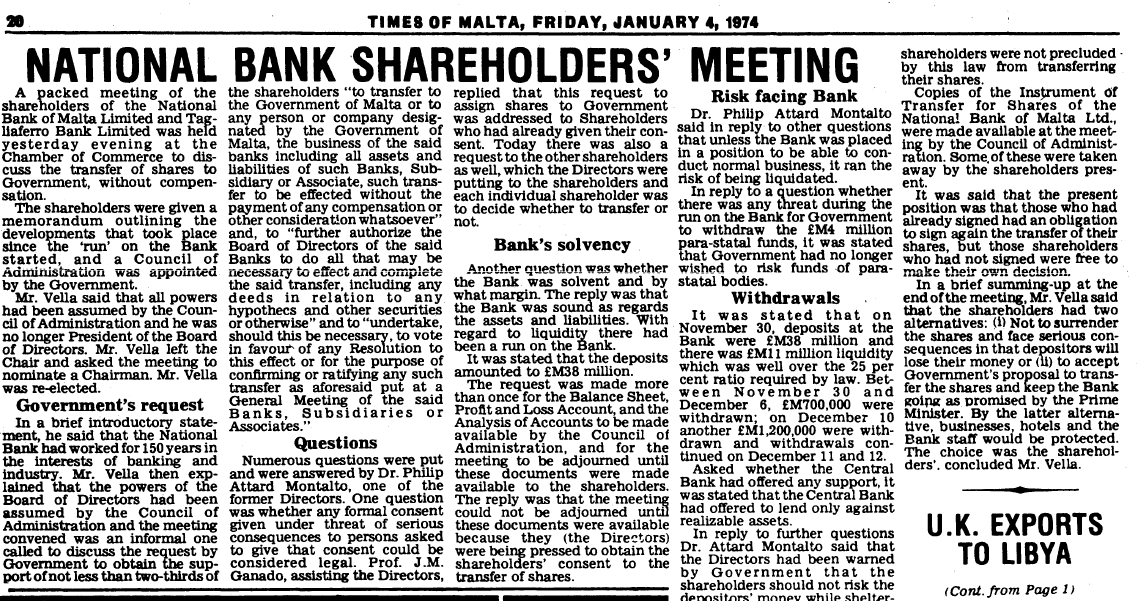
The first shareholders’ meeting after the bank heist
Times of Malta, Friday, January 4, 1974
NATIONAL BANK SHAREHOLDERS’ MEETING
A packed meeting of the shareholders of the National Bank of Malta Limited and Tagliaferro Bank Limited was held yesterday evening at the Chanber of Ceommerce to discuss the transfer of shares to Government, without compensation.
The shareholders were given a memorandum outlining the developments that took place since the ‘run’ on the Bank started, and a Council of Administration was appointed by the Government.
Mr Vella said that all powers had been assumed by the Council of Administration and he was no longer President of the Board of Directors. Mr Vella left the Chair and asked the meeting to nominate a Chairman. Mr Vella was re-elected.
Government’s request
In a brief introductory statement, he said that the National Bank had worked for 150 years in the interests of banking and industry. Mr Vella then explained that the powers of the Board of Directors had been assumed by the Council of Administration and the meeting convened was an informal one called to discuss the request by government to obtain the support of not less than two-thirds of the shareholders “to transfer the Government of Malta or to any person or company designated by the Government of Malta, the business of the said banks including all assets and liabilities of such Banks, Subsidiary or Associate, such transfer to be effected without the payment of any compensation or other consideration whatsoever” and, to “further authorize the Board of Directos of the said Banks to do all that may be necessary to effect and complete the said transfer, including any deeds in relation to any hypothecs and other securities or otherwise” and to “undertake, should this be necessary, to vote in favour of any Resolution to this effect or for the purpose of confirming or ratifying any such transfer as aforesaid put at a General Meeting of the said Banks, Subsidiaries or Associates.”
Questions
Numerous questions were put and were answered by Dr. Philip Attard Montalto, one of the former Directors. One question was whether any formal consent given under threat of serious consequences to persons asked to give that consent could be considered legal.
Prof. J. M. Ganado, assisting the Directors, replied that this request to assign shares to Government was addressed to Shareholders who had already given their consent. Today there was also a request to the other shareholders as well, which the Directors were putting to the shareholders and each individual shareholder was to decide whether to transfer or not.
Bank’s solvency
Another question was whether the Bank was solvent and by what margin. The reply was that the Bank was sound as regards the assets and liabilities. With regard to liquidity there had been a run on the Bank.
It was stated that the deposits amounted to ₤38 million.
The request was made more than once for the Balance Sheet, Profit and Loss Account, and the Analysis of Accounts to be made available by the Council of Administration, and for the meeting to be adjourned until these documents were made available to the shareholders.
The reply was that the meeting could not be adjourned until these documents were available because they (the Directors) were being pressed to obtain the shareholders’ consent to the transfer of shares.
Risk facing Bank
Dr. Philip Attard Montalto said in reply to other questions that unless the Bank was placed in a position to be able to conduct normal business it ran the risk of being liquidated.
In reply to a question whether there was any threat during the run on the Bank for Government to withdraw the ₤M 4 million para-statal funds, it was stated that Government had no longer wished to risk funds of para-statal bodies.
Withdrawals
It was stated that on November 30, deposits at the Bank were ₤M 38 million and there was ₤M 11 million liquidity which was well over the 25 per cent ratio required by law.
Between November 30 and December 6, ₤M 700,000 were withdrawn; on December 10 another ₤M 1,200,000 were withdrawn and withdrawals continued on December 11 and 12.
Asked whether the Central Bank had offered any support, it was stated that the Central Bank had offered to lend only against realizable assets.
In reply to further questions, Dr. Attard Montalto said that the Directors had been warned by Government that the shareholders should not risk the depositors’ money while sheltering behind the limited liability.
It was then asked whether the question arises; did the shareholders sign under a threat or under pressures, and, if this is so, under such circumstances are such signatures legally binding?
Demand for general meeting
There was a demand for a general meeting; this could only be called by the Council of Administration because of Act No XLV of 1973, Part II Council of Administration, Para 4, subsection (2) which states that all the powers of the Boards of Directors, or of any Director or Shareholder, and of the Banks in general meeting shall remain in abeyqnce.
The question then put was that once the powers of the shareholders had been put in abeyance by this law, can they transfer their shares. Prof. Ganado replied that he was of the opinion that shareholders were not precluded by this law from transferring their shares.
Copies of the Instrument of Transfer for Shares of the National Bank of Malta Ltd., were made available at the meeting by the Council of Administration. Some of these were taken away by the shareholders present.
It was said that the present position was that those who had already signed had an obligation to sign again the transfer of their shares, but those shareholders who had not signed were free to make their own decision.
In a brief summing-up at the end of the meeting, Mr. Vella said that the shareholders had two alternatives: (i) Not to surrender the shares and face serious consequences in that depositors will lose their money or (ii) to accept Government’s proposal to transfer the shares and keep the Bank going as promised by the Prime Minister. By the latter alternative, businesses, hotels and the Bank staff would be protected. The choice was the shareholders’, concluded Mr. Vella.
13 Comments Comment
Leave a Comment
Daphne, was the National Bank in any way related to Barclays? Or was that a different episode of Mintoffian entrepreneurial spirit?
[Daphne – I’m sorry. I don’t quite get what you mean.]
Wasn’t there a Barclay’s bank in Malta in the early 1970s? Hadn’t Mintoff taken that over too after a row with the local owners?
[Daphne – Please don’t make me desperate. Yes, of course there was Barclays Bank in Malta. Mintoff took it over, by very different means, and it became Mid Med Bank. Then, it was sold to HSBC and it’s now HSBC. I can NOT believe Maltese people know so little of even their recent history.]
At least I asked and admitted my ignorance on the subject. Little appears to have been written about Barclays in Malta – all I remember was a beggar of sorts always sitting in front of the bank (in Valletta). I was a little lad then. Hence my question to you since you appear more up to date on the issue. Perhaps a post could help.
Barclays Bank had been in Malta for eons. Initially it was Barclays Bank Dominion, Colonial, Overseas.
When the subject of colonies and domination was treated as it should have been, it became Barclays Bank DCO. In the Sixties it became Barclays Bank International Ltd.
This was the bank that dear Mr. Mintoff tried to get his paws on, but Head Office’s board of directors told him to go jump in the nearest Mediterrenean – they just upped and left Malta and the bank became the banka tal-lottu farce more commonly known as Mid Med Bank Ltd.
Barclays was another bank that was taken over to become Mid-med. Mintoff wanted to own and control all the banks in Malta.
Two different banks. Both banks eventually succumbed to the Mintoff greed.
Heads they win, tails we lose.
Such was Mintoff’s slyness and complete disregard to his own citizens’ welfare.
However, he did ‘rid’ us of the British, didn’t he?
He got us Gaddafi and Kim il-Sung, Caucescu et al, instead. What a windfall!
I may be wrong but I believe that Eddie Fenech Adami, on becoming prime minister, made Edgar Mizzi a special advisor on the National Bank saga. We all know Mizzi’s close and personal professional relationship to Mintoff.
Dear oh dear Daphne: it seems that even the biggest diehards are oblivious to this hijacking. Fancy muddling the Dick Turpinlike gazumphing of the National Bank with the Barclays takeover which I remember well as I had already been employed by Barclays for almost two years.
I even got a terminal benefit and because I was under 19 – an ex gratia payment to taparsi make up for the monthly cut down to minimum wage which in those days was sizeable, £65.
The National Bank case was not a quarter so civilized was it, as you should know as the Mr Vella who chaired the famous meeting was your grandfather. I agree with Milica Micovic that ‘justice delayed is justice denied’. This case must be solved, and fast.
Joseph Muscat has no plans to solve it fast. In fact, he plans to assemble “a ‘team of advisers’ to draw precise conclusions on the implications of the National Bank court case.”
Joseph Muscat must be hoping that once the court delivers its decision, it will take his “team of advisors” another 35 years to draw precise conclusions.
I think the judge in charge of the case should hang his head in shame and try not to appear in public.
I believe that the case has been handed over from judge to judge over the years. It looks like nobody wants to take responsibility.
In the Times on-line following I.M. Beck’s article on Saturday, May 26, 2012 “Which is the greater sin?”
Joseph Borg Today, 17:41
Mr Laiviera whether Ms Vella is a shareholder or not is not really relevant. What is relevant is whether what happened back in 1973 was legitimate or not.
By all accounts this was an illegal and immoral act. To accept that one must also accept that Mintoff was a robber no less. On Xarabank a few weeks ago when they were meant to discuss the film Dear Dom, jeremy Cassar Torregiani made an intervention and Toni Abela was very quick to chastise his nationalist counterparts for not having done anything to settle the claim. In so doing he is acknowleding that the shareholders have a claim and that therefore Mintoff committed an illegal act using his authority to steal what he wanted, otherwise they would haven no claim at all.
This case is about so much more than compensation to the shareholders. It is about the fact that our Republic was built on theft. That its foundations are corrupt to the core. In committing this crime, Mintoff did not steal from the rich to give to the poor. He created a new wealth order and impoverished some in the process. Like this he controlled the economy as these new wealthy owed their beginnings to the theft he committed. How easy it is to build a business like that. on the back of others. It is most likely that we will find some recipients of our National Merit of order amongst these. Some wishing now to leave a legacy of integrity. What irony. What hypocrisy.
It is only too easy to make the taxpayer the fall guy. For there to be true justice in this case, not only should compensation be paid to the shareholders but anyone who benefitted from this illegal and corrupt act should be made to make good for what happened. Presciption pleas should not be permitted in the name of the common good to somewhat give some level of dignity to the rule of law and order in this country which was so flagrantly disregarded by Mintoff and all those who went along with his scheme.
People have since died and the courses of destiny changed by this action so any form of compensation can only be a mere token to the real loss sustained. Mintoff himself should be held accountable. Regardless of whether his own personal coffers benefitted from this act (and a full investigation should be made to see whether they did), he went ultra vires his authority as prime minister by taking the bank using the tactics that he did. It is about time that public officers were made accountable for their actions and not simply shove the burden on the taxpayer