
Those young people who can do so should pack up and leave. It’s only going to get worse.
Manufacturing is the future and the prime minister encourages young people to take up jobs in manufacturing.
Advice to young people: get your first degree at the University of Malta, pack up and GO. Go, and go quickly, before you end up stuck here in a rapidly deteriorating situation. And I am not necessarily talking about the economy, either.
Advice to parents: remember that there’s a whole lot more to life than being ‘comfortable’, driving easily between five or six haunts, and mixing with the same people you’ve been mixing with all your life.
The world has changed, is changing every day. The cosiness you value now about life in Malta will have gone by the time your children are your age, and that’s not a bad thing. If the prime minister doesn’t know that, you should.
56 Comments Comment
Leave a Comment
http://www.inewsmalta.com/dart/20130726-tmin-xhur-abs-fuq-traffikar-ta-eroina
Ara min kienu l-avukati.
Nistghu nibqghu sejrin hekk jew? Il-Kummissarju tal-Ligijiet…jaghmilhom a la carte
I saw the Times of Malta article just before I saw your post, Daphne. I kid you not – a couple of hours before that I was browsing some international job search web sites for possible opportunities because I’m realising that the prospects are so bleak that I’d rather jump ship before it’s too late.
I can’t believe the Maltese shot themselves in the foot so bloody thoroughly.
They’re governing the country as if it were the 70s all over again and 25 years of a *really* progressive Nationalist administration hadn’t even happened.
Manufacturing has long since been the domain of China.
So are we missing something here?
No, we are not missing something here. We are now a de facto province of China.
Made in Muscataiwan. That’s the new mark of quality.
Does this mean that he’s looking forward to seeing his daughters sewing back pockets on jeans in a factory in Bulebel?
Sure…daqs kemm dahal hu fil-qasam tal-manifattura bhala machine operator.
Spot on. What manufacturing?
Latest statistics,
unemployment’s up by 600, that’s a 9% increase, ONE blamed, obviously, the previous administration.
Cruise liner figures dropped a whopping 37%, blame GonziPN.
In 1987 Malta had over 24,000 out of work, in 1998 deficit spending shot up to 13%.
July’s the month 4,000 graduates enter the market.
Five month’s half a year, budget talks imminent, statistics ground to a halt. Meantime they plan to double the cost of that ludicrous project in Marsaxlokk and enter an endless saga with the EU and its international contracting regulations.
And then, hopefully, they’ll try to reduce energy bills to make this place competitive.
It’s not good.
A f**king amateur clown for a PM.
He isn’t funny any more. The clown.
And here I was thinking that Europe was progressively moving towards an information based economy, where knowledge in IT, research and pharma was increasingly valued.
Guess I’ll have to rethink…
I have to be fair and say that I agree with keeping manufacturing alive. I think a country is what a country makes. In fact, one of Europe’s major issues is that it has too many unemployed ‘graduates’ who basically leave university with no applicable skills. Look at Italy. A country of unemployed lawyers. Malta’s size make it a bad location for manufacturing however.
Oh god, where do I start?
The point of having a common European market and a common job market is so that single countries no longer need to have the full range of economic sectors on their territory. This is the point about the EU that Maltese politicians, including Lawrence Gonzi (yes, him) have never understood.
Malta has neither the area, nor the location, nor the resources nor the history for a manufacturing sector.
Labour, as we all know, is a crock of shit in economic policy, so I won’t dignify it with a comment.
But our pundits say that the PN has a liberal economic policy. Not really. A real economic liberal would not provide government aid and make policies to encourage the survival of unsustainable economic activities. I’m not just talking about the dockyards and shipbuilding..
Perhaps Simon Busuttil understands this better, but quite frankly I doubt it.
Damn it’s so hard to be optimistic these days.
Oh and Europe’s major issue is China. Bloody China. We’re playing on the same field under different rules. It’s just crazy.
I don’t expect Joseph Muscat to do anything about THAT. I mean, one doesn’t inconvenience the paymaster for the sake of our European future, does one?
Definitely keep manufacturing alive because there will always be a sector of the workforce that have the relevant skills for it. But it is not an area that needs promotion by the Prime Minister.
That’s the sort of rubbish thinking that kept Malta back for years. You can’t magic an economic sector into existence if there isn’t a market for it.
The adage, “a country is what a country makes” is as outdated as the hills. The services industry has taken the place of manufacturing in all parts of the world where workers are not content with earning around $30 a month.
Instead of producing a pair of jeans, you’re providing a service which is far more lucrative than producing a playmobil figure. When export figures are released, they are not referring to manufacturing exports only – a very high percentage of that would be coming from the services industry.
There is no way in hell that Malta can compete in low-skilled, routine manufacturing. China’s cornered the market there and lots of other jobs in the textile industry here have been exported to Tunisia, another high-volume, low-pay labour market.
Muscat is beyond irresponsible if he really means to encourage the young to take that route, but the cynical little bastard probably doesn’t give a damn either way. I don’t imagine he’s losing any sleep over the labour market, never having had to face any sort of insecurity himself.
You cannot be serious! The PN where capable of creating jobs for graduates by investing and creating new opportunities.
They explored new fields like e-gaming among others. Every graduate found employment immediately unless he/she decided to further his/her studies through the Erasmus and other European funded programmes.
This is purely a let’s follow China rather than Europe attitude.
At least my kids are lucky enough to have graduated and did not have to face the trouble I encountered to reach my goal.
However I feel sorry for those whose kids are going to have to struggle to get to their degree because of this incompetent, socialist, self-centred prime minister.
I wonder what plans he has for his two daughters. Perhaps he will start them off by giving them private lessons in sewing, so that they can take up his mother’s trade.
I’ve never been more serious.
The PN wasted twenty years of the nation’s life by keeping the shipyards and Air Malta afloat, when it was clear they were doomed.
They did it out of social considerations, not economic imperatives. That money could have been spent elsewhere, in more productive ways.
Then they kept the economy going by boosting the construction business, so that a few fat cats could get spectacularly rich while employing lots of cheap, unqualified labour.
The perfect antithesis of the PN’s much-vaunted “Vizjonijiet”. The PN are not economic liberals, but Christian Socialists. I’d repeat the very same words to Lawrence Gonzi’s face if I could.
Malta doesn’t need more lawyers. The lawyers are already treading on each other’s toes.
It needs more scientists, medical/pharmaceutical professionals, IT people, engineering people, specialists in telecoms and gaming (and I don’t mean online gambling). It needs more investment in education and in technological, scientific, medical research.
We need to invest in schools and higher education institutions that concentrate on scientific and technological education (take MIT for example!). We need proper, well funded research centres in the hard sciences, medicine, computing, AI, technological arts. Research centres maintained through partnerships with the technological multinationals and European universities and educational institutions.
Most of all we need to make students understand that this is the future and that the future is EXCITING and FUN. A coordinated national campaign to steer youngsters towards a the path of scientific training is sorely needed.
The previous administration managed to make a start towards this, even being hobbled by the head of the Council for Science and Technology who’s only interest was in imbibing Earl Grey tea and putting spokes in the wheels.
To hell with manufacturing. Manufacturing has been dying in Europe for decades. Why should a youngster bother to get an education to spend the rest of his miserable life pulling levers at some assembly line?
Europe has the best schools and universities (even better than the much hyped US institutions – just ask any American science professor). It has the potential of being THE world centre for research and development in science and technology. With just a bit more imagination and a lot less bureaucracy Europe could easily attract the best minds from all over the world.
With some vision, we could have been at the forefront of all this. Think a Silicon Valley in the Med.
But Joseph Muscat wants students to concentrate on manufacturing.
It would have been funny hadn’t it been so fucking tragic. Daphne, I’m sorry for the vulgarity, but in this case I believe it is completely warranted. Feel free to edit it out.
You really have to read to the end of the article. Muscat is organising a meeting with the Education department to make sure people go into manufacturing.
What are they planning to do? Dismantle schools, make sure no one gets an education and then herd them all into mind-numbing monotony for the rest of their lives?
Maybe after ghettoising LGBT, they will now create a new section called Child Labour?
I can’t help thinking how increasingly weird the prime minister looks. Also, wise words of yours, couldn’t agree more.
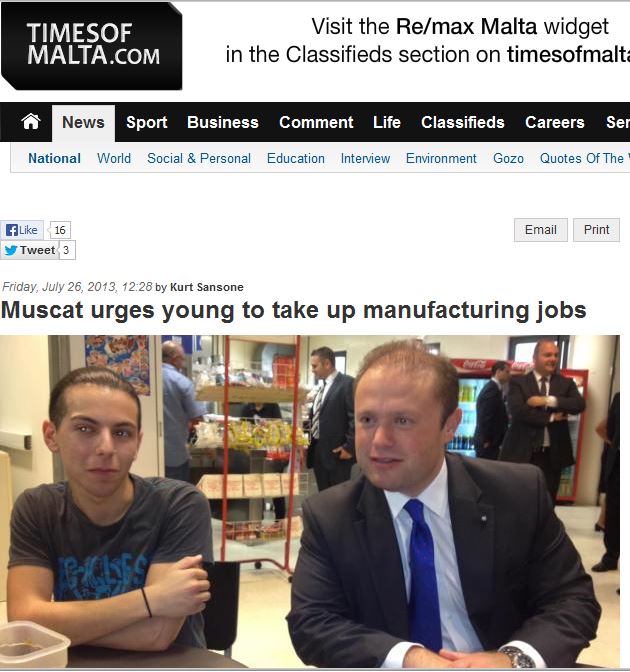
In the picture shown above the PM looks scary.
Before working in manufacturing you need the factories. Or could it be that the government will create manufacturing jobs in the civil service?
I almost didn’t recognise our PM, it’s been so long since anyone clapped eyes on him.
Re the article: The man is just so indescribably dense. Like a briksa maybe?
But on the plus side, that’s a SPECTACULAR photo of him. Did they PhotoShop his head to look like a balloon or is it really swelling by the day?
How come no one of Muscat’s billboard boys and girls was encouraged to take up a carreer in manufacturing?
There is manufacturing and quality manufacturing.
Austin Gatt almost screwed it all up when he had decided that it was not manufacturing that was required for the future but IT.
Never put ALL your eggs in one basket.
When the banking disaster came, IT, gaming and internet based business simply got shot, manufacturing was also hit but not killed.
Malta managed to keep afloat because of manufacturing and Dr. Lawrence Gonzi who managed it perfectly.
IT industry brings nothing to Malta except money and highly paid foreigners along with highly paid Maltese, which is very good.
The problem is that if they have to leave, they just switch off the servers. Not manufacturing, this is like a big wheel – it takes time to get it into full speed , but it also takes time to stop it.
[Daphne – No, it doesn’t. Factories close their doors within hours if that is what is required and there is no alternative. Denim Ltd did just that a couple of years back, with 800 out of work overnight.]
High value manufacturing (whatever that means) was identified by MCAST under the previous administration as one of four streams onto which to focus innovation.
I guess a balanced approach would work, affording some space for niche engineering / manufacturing in addition to tourism, financial services etc.
I recall that when Dr. Gonzi was Prime Minister he used to encourage young people to study to get a degree and even a second degree.
This prime minister encourages young people to work in manufacturing. Most employees in the manufacturing industry are machine operators.
What a contrast… and some students had the cheek to say “shame on you” to Dr. Gonzi.
Shame on you Joseph Muscat.
Why didn’t HE take up a manufacturing job?
They shouldn’t even be considering a degree at the University of Malta, as it’s practically worthless beyond the shores of Gozo. They should be aiming at getting good grades in their A-Levels and leave before it’s too late.
[Daphne – Not true at all. I speak from experience. A first degree from the University of Malta is much, much better than a first degree from some minor British university, which is all most Maltese would manage to get into at 18, given the competition. Armed with a first degree from Malta’s sole university, you can then compete favourably for a postgraduate at the best British (or other) universities.]
Hang on a minute. In which field?
I second Daphne. I received my first degree from the University of Malta and then went to a top UK university for my PhD.
I was much better prepared for this than most of the others from other universities.
The degree in Malta gave me the necessary technical knowledge as well as the tools necessary to also handle gaining new knowledge independently and use it successfully. I cannot stress how important the second part of this is.
From the way you write, I know it was your own skills, not the University of Malta, that made you successful.
Will the person hitting the rewind button take a holiday!
It feels like we’re going through a time warp, going back 30+ years. What next? L-industja tal-kappar? Fabbrika tal-elf? Bozza mitfijja u ohra le fit-toroq?
Dirghajn il-Maltin? Bahhar u Sewwi? I hope that the next budget will not be dictating the price of coffee or tuna. Those of you my age will remember.
Someone needs to get a reality check.
The younger generation need to be encouraged to study, to get qualified, to get into higher paid jobs, to give better added value, to have a better quality of life.
All in all. to be better, and better off, than the last generation. To help the country to move along on an upward tack, we need to think better, faster, bigger, stronger. We have to aim high, not low.
The PM should be giving better advice than this, and besides, he should be racking his brains on how to attract industries which need such value added employees.
The past years have yielded important sectors like financial services, aircraft maintenance, the pharmaceutical industry, the IT sector. The list goes on and on. Now the PM encourages factory work.
This can only mean one of two things. Either the policy is to go down this road, or there is not enough grey matter in the flock to look into the future to attract the industries necessary to absorb graduates into their working life.
God forbid.
http://www.inewsmalta.com/dart/20130726-addejin-negozjati-bejn-malta-il-libja-ue-dwar-immigranti
They can’t even get a name right: Matthias Fauser became Mr Hauser.
At Playmobil there’s not much China-type manufacturing, as most figures are machine assembled and robotics are the order of the day…. 2,500,000 figures per WEEK.
I dare say that Playmobil (Malta) is the biggest employer in Malta. There are many subcontractors providing services to this big German family-owned business (the economic multiplier effect). Many businesses in Malta depend a lot on the custom of this big toy manufacturer.
Above all it is one of Malta’s best employers and far better than many Maltese-owned businesses. Operators who work at Playmobil rarely quit their jobs for a better one.
I know people there who have been working for ten, fifteen and even twenty-five years.
Manufacturing has a future in Malta – the other option for young people is to get a degree at university and find a job in Australia, Canada, Germany, or the UK, where I must say that they will find the Norman Lowell locals putting spokes in their wheels to get employed and a permanent residence permit.
The world is not much different than Malta nowadays, Daphne.
[Daphne – Manufacturing may have a future in Malta, but it does not follow that Maltese people should have a future in manufacturing. The sort of jobs the prime minister is talking about here are not engineering jobs, or management jobs, but unskilled labour: literally cogs in the machine. It is fundamentally wrong to treat human beings like fodder to keep the machine going, manipulating them into low-paid jobs with no hope of improvement or promotion, just to keep the machine going. The world outside is indeed very different to Malta, some better, some worse. Young people should leave for places that are better than Malta, and if I were their age I would have absolutely no hesitation in doing just that. In Malta, you hit a brick wall and can go or grow no further, end of story. It’s a very, very high price to pay for being cosy and comfortable, two things which can be saved for the coffin.]
“The sort of jobs the prime minister is talking about here are not engineering jobs, or management jobs, but unskilled labour”
I read that Mathias Fauser was complaining that Playmobil is finding it hard to find technical people/students to manufacture high precision moulds and repair or build machinery.
[Daphne – That’s because they’re finding better jobs with better pay and conditions elsewhere in Malta or the European Union. The principles of demand and supply cannot be ignored.]
I’m quoting inews:
“Waqt din iż-żjara Muscat fil-kumpanija tkellem dwar il-bżonn li jkun hemm aktar studenti li jaħdmu fil-manifattura. Is-CEO tal-Playmobil, Matthias Hauser qal li qatt ma jirnexxilhom jimlew il-postijiet kollha li jkollhom, anke bl-istudenti fil-korsijiet tal-MCAST. Hauser qal li ċertu postijiet ta’ xogħol f’Malta diffiċli ssib min jagħmilhom bħal fil-qasam tal-‘moulding’ u ‘tooling’, li iżda, qal Hauser, ma ssibx l-istess realtà fil-Ġermanja.”
“Manufacturing may have a future in Malta, but it does not follow that Maltese people should have a future in manufacturing” . No one said that. The Prime Minister said that STUDENTS should also consider manufacturing as their career. Manufacturing encompasses the pharmaceutical companies, printing, food processing, and the building of machinery and parts assembly.
[Daphne – They don’t because it’s not a good idea or a safe choice. When you go into a job like that, your training is put to a narrow, specific use. Technology shifts overnight and before you know it, your skills are redundant and you’re out of a job. Printing is, in fact, the perfect illustration of this. Over the two decades I’ve worked in related fields, I have seen production systems change completely and dramatically, and change overnight. The way we work now, in this field, bears absolutely no relation to the way we worked 20 years ago.]
Don’t Italy, Spain, Germany, France and the UK have factory workers making cars, filling cans with food, printing carton boxes, making chocolate bars, assembling electronic products, and producing toys?
[Daphne – Yes, but many of them are immigrant workers because the Italians themselves won’t do it, unless they are desperate. I once toured a meat factory where a group of young men spent their entire working day literally putting their arms up the backsides of hanging cattle carcasses and scooping out the excrement. None of them spoke Italian. That was the worst. The second worst was a canning factory where the floor employees spent eight hours a day at a noise level so high that I couldn’t stand it for eight minutes. They wore ear protectors, but so what. Nobody wants to do these jobs anymore, that’s why they are being filled by immigrants from poor countries, who have no choice and whose expectations are lower. Don’t misunderstand me. In the course of my working life I tour many factories and production units.]
What’s the use of enticing young people to a career in teaching for example when the student population is dwindling? As Mr Fauser rightly said you won’t find this reality in Germany where on the contrary, people choose a career in manufacturing.
[Daphne – They choose it at a higher level, and at the lower levels, pay and conditions are very good – so good that Playmobil is in Malta, not in Germany, because pay and conditions here are more advantageous to the company, not those who work for it.]
This is where the previous PN administration got it wrong; when addressing young people it always mentioned STEPS, university student population, MCAST and jobs in the tertiary sector.
It ignored the young people who had a job in the manufacturing sector which you are deriding.
[Daphne – I do not deride it, John. I am a capitalist by nature and inclination. By my attitude is simple: if working on a factory floor is not good enough for my children, it’s not good enough for other people’s children. If they do it because they have to, rest assured that they too will want something better for their children. This is the way of the world. It is the reason why factories are moving to poorer and poorer countries where people are desperate for work and their expectations are lower, and it’s also the reason why Europe’s factories are filled increasingly, on the actual factory floor and in the warehouses, by immigrant labour. This is what I see when I visit factories in Europe, and I am sure that it is your experience too. There is something else I have noticed, which is related: the only two places in Europe where I have encountered ‘native’ chambermaids in hotels are Sicily and Malta. In Sicily, the chambermaids are Sicilian and in Malta, the chambermaids are Maltese, though increasingly not as the standard of living improves. Everywhere else I have been, the chambermaids are immigrants.]
Don’t other countries offer employment for cleaners, builders, auto mechanics, farmers and other ‘dirty’ jobs. Where would you employ someone who is not academically inclined or dropped out of university but is enthusiastic on how things work?
[Daphne – There are other jobs, many of them related to IT. Jobs in mechanics needn’t take you into a factory. That kind of training is the perfect basis for setting up a small business and employing others, in an environment that will be more congenial to them too. Cleaners and builders everywhere in Europe are immigrants from poorer countries, even if those poorer countries are other EU member states. It’s a chain. In Malta, many of the people doing these jobs, and that includes working in the fields, are African immigrants. Not being academically inclined does not equate with being unfit for anything other than manual work. I was never academically inclined. Even with a gun to my head I wouldn’t have spent an afternoon studying, let alone days or weeks or months or years doing so. But it didn’t follow that the alternative was sewing jeans in a factory.]
Even though Muscat did not address this subject on this occasion, as PM he knows he should cater for everybody including those who dropped out from school. This ‘enormous crowd of (tattooed) voters’ was not properly recognised by the PN in the last election.
[Daphne – That is a wrong attitude, John. Nobody should be encouraged to drop out of school with short-sighted promises of jobs as cheap labour. There are alternatives to academic study. The trouble is that the kind of children who don’t stay in school beyond 15 or 16 generally come from families who haven’t a clue what’s available or what the options are, how to guide their children. The children know even less. There are children who drop out of formal schooling at 16 or 18, and who went to private schools, but they generally come from backgrounds where they don’t go into manual labour, and they know enough about to alternatives to get going with them. Otherwise, their parents keep them afloat until they get their act together, which can take years.]
An economy which depends on the tertiary sector only is not a healthy economy, a country has to physically produce and export consumables to be classified A+.
[Daphne – Yes, that’s why immigrant labour is such a crucial component of the European workforce, and why there were headlines recently saying that without more immigrant labour, Britain is going to be in trouble. And the simple division of ‘tertiary education’ vs ‘manual labour’ no longer exists. There is a whole world in between.]
Every month we read about how the global economies fared, they quote wether manufacturing increased or decreased and what lies ahead, then the stock markets react on the data provided.
Look at Germany’s economy which has a vibrant manufacturing industry and look at the US whose economy collapsed because it was depending on speculation.
[Daphne – Not quite a simple as that. Germany’s vibrant manufacturing industry is completely dependent on immigrant Labour, either from the poorer EU member states or more pertinently from Turkey. Its manufacturing industry in Solingen was for decades dependent on poor labour from Sicily and southern Italy. The place is literally a ‘little Italy’. The United States has problem precisely because its immigration controls are so tight. It is the textbook illustration of a liberal economy but with one major flaw: no freedom of movement of workers. This means that a crucial factor for the proper functioning of the liberal market is missing: poorer people coming in at the bottom to take the jobs others leave behind as they move up the economic ladder. Illegal labour from central America partly solves the problem, but the illegal status of these workers means that they cannot be properly integrated into the system. The US economy was NOT built on speculation. The collapse was brought about by ill-advised lending to families; this in turn had a knock-on effect in manufacturing, as bankrupt families couldn’t spend money. ]
Muscat was right on this one. Now we’ll see when Evarist meets Fauser. Maltese people should also consider working in the manufacturing industry, like the Germans do, after all.
[Daphne – No, I am sorry. Muscat is wrong. His job is to make life better for Maltese citizens. It is also to make sure that exporters keep their manufacturing base in Malta. The solution to doing both is allowing immigrant labour into the country to do the poor jobs while making sure that the Maltese have enough training and education to get far better prospects and income. What you and Muscat suggest is a recipe for fossilisation of society and the economy. The situation in Malta is the reverse of what it should be, the reverse of what it normally is. The ‘immigrant labour’ component of the workforce numbers tens of thousands, mainly EU citizens, but instead of taking the poorer jobs, they are better qualified than the Maltese and doing the good jobs, while the ‘natives’ remain stuck in manufacturing and cleaning. Instead of having Romanians and Poles and Sicilians coming to Malta to clean and do jobs in factories, as happens in the richer EU member states, we have Scandinavians and Finns and Britons and French people coming here to do the good jobs. I go to offices where I find Maltese people cleaning the floors and answering the telephone, while citizens of other EU member states are behind the desks or taking the decisions. It should be the other way round, but you and the prime minister clearly think otherwise. ]
John Schembri, I don’t have Daphne’s patience, so I will keep my answer short.
1. You say that Malta should have a manufacturing sector “like Germany”. What an unbelievably stupid comparison. Malta and Germany are worlds apart.
2. Both the PN and Labour have their economic policies fundamentally wrong. They try to fit economic sectors to available workforce, when it should be the other way round. You could do it in a Mintoffian-type economy, of course, which is where most of our economist gurus were schooled. But you cannot do it in a free economy where the government has no control over private industry. Hence the total panic when ST Microelectronics was about to shut down its Malta factory and set up shop elsewhere.
In a free economy, you train your workforce so they can find jobs. And the jobs IN MALTA are not in manufacturing.
3. There is a way to reconcile your views and mine. Encourage EMIGRATION. After all, that is why we joined the European Union. Leastaways, that is why I wanted to join it. Maltese workers who wish to work in manufacturing can go to Germany. Malta has always been a country of emigration, at least for the last two hundred years when it really got overcrowded. The British administration knew it, and they tailored their policies accordingly.
Not the modern Maltese. They cling to this tiny speck of rock as if it were their only lifeline. If you can’t find a job in Malta, pack up and leave. Or retrain as a programmer, and stay put.
H.P Baxxter,
I voted for the EU for freedom of movement and for a better quality of life among other things.
Maltese workers have a right to work where they want in Europe.The way you put it is that whoever wants to work in the manufacturing industry has to leave his homeland if he doesn’t find a job.
Every country should have a manufacturing sector like Germany not in size but in the same ratio if possible. Governments have to provide work for everybody ; the academics and the blue collared.
Presently the other ‘career opportunities’ which MCAST students have are with the Maltese owned family businesses which don’t pay and have quasi medieval working conditions.
What the colonialists thought about us is not valid. They put their imperialist interests first, not yours, that leaves you looking from the wrong angle.
What Muscat said inter alia, was that apart from the gaming industry, nursing , catering and jobs in the tertiary sector there are opportunities for students to take up in the manufacturing sector like mould making and tooling which by the way are the nadir of precision engineering : a well paid specialised job and not only at Playmobil.
Muscat was right on this one, and I hope the PN understands and agrees with his opinion.
John Schembri, this is turning out to be another impossible conversation.
The way you put it, the prime minister should provide jobs to match all the skills of every Maltese citizen. That means we should have things like a national ballet company, a national nuclear programme, an Olympic bobsleigh team, and a national Bio-Safey Level IV laboratory where smallpox samples are kept for research.
You go ahead and pay for all this, John.
No one said that, Baxxter. And if I did not explain myself clearly, I apologise.
We will always have people with no tertiary education or who are inclined to do manual jobs rather than sit behind a desk. There is quite a big chunk of people in Malta who are happy working in the manufacturing sector.
In an office one needs someone to do the errands and the cleaning. In industry one still has to have managers, accountants, engineers, tool makers, technicians, and machinists to run a factory.
No one is asking for special treatment – these workers pay taxes like everyone (and even more than some academics who represent us in parliament) and inject much needed hard cash into the country’s economy with what they export.
There’s all of the European Union too.
U Joseph ghandu dottorat fl-ekonomija…. maaaaaaaaa
So the previous administration did its best to move on to the next stage in an economy’s development – a services based industry and the digital economy – and Muscat wants to go back to an emphasis on manufacturing.
What next – a wage freeze?
Doesn’t he realise that we have long been too expensive for the greater part of the manufacturing industry and could only compete in manufacturing with relatively high value added. Doesn’t he know that our own home-grown manufacturers have been shifting operations to places like China, India and Tunisia?
Since our higher wages are the reason why we have become so expensive, what does he intend to do to lower wages?
And, by the way, isn’t Muscat supposed to be an economist? Ekonomista tas-sold u nofs pero, kif kien jgħid in-nannu.
My sentiments exactly, Daphne.
When I read the headline in The Times I couldn’t help thinking about what Dr. Gonzi would be feeling after all the efforts of his government in the area of higher education.
Can you imagine having a PM whose ambitions for you are no higher than that? Talk about aiming low.
Manufacturing what?
Maybe he was thinking of coffee for the rest of Europe to smell. It could be fireworks.
That is presuming he did think in the first place.
I wonder.
Will the prime minister’s twins work in manufacturing in their adulthood?
…. Jahdmu n-nar …….
At least things will get better in 5/10 years when the Nationalist Party is voted back into government.
Dirghajn il-Maltin, Bahhar u Sewwi, Izrgha u Ahsad, Pijunieri will be back
A chav in a suit, and one with Mintoff’s ideals. Could it get worse than that?
I work in the manufacturing of electronics. It’s always a fight every day so that the work does not end up in China due to the cheap labour that they have over there.
Why should one study to find work manufacturing when from time to time factories leave Malta to go and invest in other countries like China, Morocco and so on? Also why waste time studying manufacturing when the wage is so miserable like minimum wage?
I think that everybody would like to have a decent job, good wage and a secure job.
PM, it’s better to see that factories give wages the same and not in the same factory who is paid min wage and works with contract and in the same factory and same job others are paid better and with no contract!
Kemm konna ahjar meta konna aghar.
Some time before the elections, Joseph Muscat thought we would believe he was being original when he parroted Margareth Thatcher on St Francis of Assisi’s prayer.
Now he is doing the same with his ‘bast frand’ David Cameron, who Muscat thinks fancies him.
It is a fact that David Cameron has been pushing for a resurgence of manufacturing in the British economy.
However, this is based on the historic fact that Britain was once (and possibly still is) a manufacturing powerhouse.
Malta never had a manufacturing heritage. Our manufacturing is on a limited scale, and it is usually based on foreign investment in small scale enterprises here in Malta, usually for some tax advantage or due to cheap labour cost.
Joseph Muscat should have a chat with that prime Labour apologist Lino Spiteri who has very good connections with Bortex; some years ago this company moved its manufacturing capacity to Tunisia as, comparatively, wages in Malta were too high.
Now also the facility in Tunisia has shut shop and moved to points east – Asia. Where does our PM see openings for minimum wage jobs in manufacturing? ST, where even engineers are apprehensive about holding on to their jobs with ST in a permanent state of “shall I stay or shall I go”.
This is not the 70s with denim and jeans factories employing illiterate school-leavers at minimum wage under slave-labour conditions. Or does he have the resuscitation of the “Korpi ‘ in mind? I weep for the future of Malta, if it does have a future under these people.