
Translation and comments on today’s piece in the Berliner Zeitung
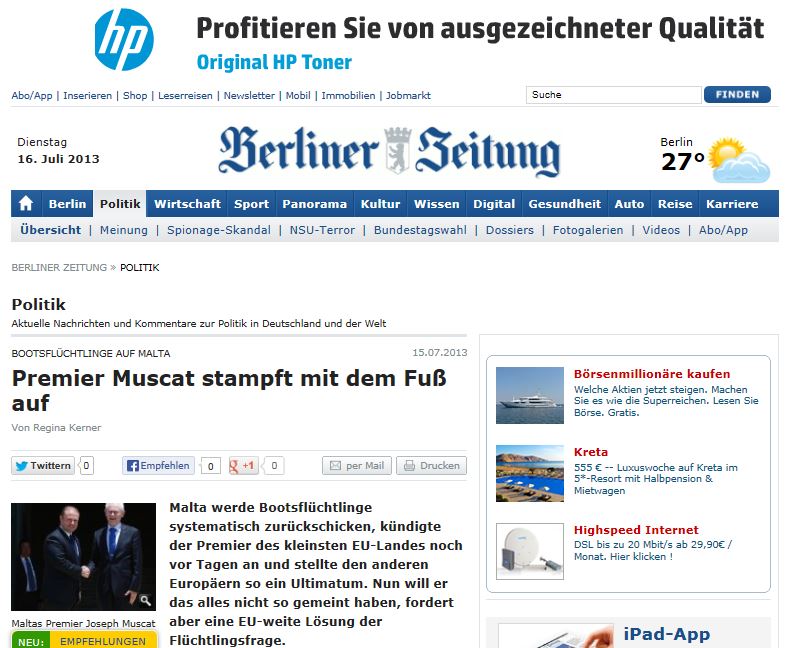
A reader who has lived in Germany for the last 15 years or so has sent this in.
The gist of the first part of the article is actually doubt as to Muscat’s intentions. It borders on subtle ridicule. “Nun will er das alles nicht so gemeint haben“ – which is basically synonymous with: “well now apparently he seems to have meant something else…”.
The interesting part is that the Berliner Zeitung might have picked up on Muscat’s xenophobic stance. The words “Systematisch zurückschicken” are carefully chosen. Germans are very careful with their use of words, and especially so with words reminiscent of their inglorious past.
“Konzentration”, “Reich” & “Führer” are all legitimate German words, for instant, but are avoided in everyday speech. The sentence does not change its importance or intonation if “systematisch” is left out, so why put it there in the first place.
I have asked a couple of native German speakers, who share my feeling on this one.
This is a very bare translation, done at work.
PREMIER MUSCAT STAMPS HIS FEET
Up till a few days ago, Malta’s prime minister Joseph Muscat declared that he would start to systematically push back illegal immigrants arriving by boat, and he gave the EU an ultimatum.
Now he is saying he didn’t really mean it that way, but that he is pushing for an EU solution to the immigration issue.
As of last week, the Maltese prime minister threatened the EU that he would systematically push back illegal immigrants to Libya, if no solution for the same crisis is found. This ultimatum stirred a lot of criticism amongst NGOs and human rights watchdogs. In Libya there is the threat of torture, mistreatment and arrest. The European Court of Human Rights stopped the imminent pushback of asylum seekers with an interim ruling.
Now in Rome, Muscat has declared that he never used push-backs as a threat, that he merely said he would be leaving all options open. “We stamped our feet and said do not leave us alone on this one,” he said.
Malta’s threats and the Pope’s visit to Lampedusa have pushed illegal immigration back onto the EU agenda. “There must be a solution across the board”, Muscat said. “the EU cannot leave any one nation to fend for itself and carry the burden”.
“The situation in malta has become unbearable,” Muscat said, “worse than in Lampedusa. Last week alone saw some 400 illegal immigrants land on our shores, Somalis and Eritreans leaving from Libya. In 2012 there were 2000. Malta is the EU’s smallest nation, and also the most densely populated. The immigrants which stop in Lampedusa are brought over to Italy, whereas in Malta they have nowhere else to go.” Muscat said he is all for integration and immigration/emigration, but the numbers are definitely too high.
Immigrants must either be “spread” across Europe, or negotiations with Libya should commence, Muscat said. Libya’s border with Chad is a no man’s land, where organised crime and human trafficking (for illegal immigration) is widespread. This has to be stopped, he said.
23 Comments Comment
Leave a Comment
That opening bit, to me, says: Muscat acted like a big baby. Then he realized he was dealing with adults, and now is crying for forgiveness and hoping the adults will just forget that ever happened.
“Muscat acted like a big baby”
He sure looks like one.
The SYSTEMATIC violation of human rights of a group of civilian persons could qualify as a crime against humanity, and may become a matter for the International Criminal Courts to look into.
http://www.timesofmalta.com/articles/view/20130716/local/ten-somalis-relocated.478269
Home Affairs Minister Manuel Mallia thanked Irish Ambassador Jim Hennessy…..by flapping his colourful wings and squawking, ‘Solidarity! Solidarity! Polly wants a cracker!’
“The situation has become unbearable”
He can say that again. Joseph Muscat, aged 39, is finally having to take some sort of responsibility.
News Flash: ‘Xarabank (this Friday) to hold panel discussion to determine if we have a race problem. Invited panelists include Norman Lowell, the Archbishop, PM Muscat and some illegal, sorry, irregular immigrant. Audience must leave all weapons at door.’
Out with Canadians! Bloody moose-hunting hockey-playing ice-fishing Canucks! Power-walking all over the place too! Can’t have that! And they’re taking over the traditional Maltese doughnut industry!
Sorry, part of our nature. (culture?)
If, as he is saying, there were only 2000 irregular immigrants in Malta in 2012, then I believe there are even less than the 4000 which we keep hearing about. Can’t call this a storm in a teacup as this issue has taken on a lot of serious and frightening connotations but now I’m sure that these poor souls were used as a smokescreen by Muscat to divert attention from the really big scandal.
The way the German article is written is very humiliating for Malta. It does not just state what happened. It is full of statements ridiculing the way Muscat went about the issue: “a -sort- of ultimatum to the EU”, “-Now- Muscat claims…”, “one -simply- announced”, “-negotiate- immigrants with Libya”.
Daphne, is there a possibility to get hold of a recording of Muscat’s speech in Rome? I really want to know whether he said “stamped our feet” or whether it is just the German translation for “put one’s foot down”, that makes use of the word “aufstampfen”.
One thing is for sure. Joseph Muscat really put his foot in it with his crowing about sending back asylum seekers, without even informing them of their fundamental rights and of the protection that they are entitled to under international law.
He did say “stamp our feet” . Even the Maltese press reported that comment.
I have found several english sources stating the same in English :(
http://www.independent.com.mt/articles/2013-07-15/news/my-government-is-keen-on-migrant-integration-pm-2078900225/
http://m.maltatoday.com.mt/newsdetails/news/national/On-migration-Muscat-hints-that-Malta-must-get-its-numbers-right-20130715
Isn’t it incorrect to say “stamped our feet” in that case? A child stamps its feet to make noise when it wants something. A person puts its foot down when it wants to make a firm assertion.
So Muscat is still a child after all. Stamping his feet instead of making his point clear.
I agree, the word systematically is a very negative one with very negative connotations, most commonly used before other words like ‘abuse’, ‘slaughter’, ‘eradicate’, ‘torture’ to mention but a few.
Interesting reading:
http://www.maltatoday.com.mt/en/blogsdetails/blogs/Phoney-Christians-applauding-a-phoney-liberal-20130715
“Libya’s border with Chad is a no man’s land, where organised crime and human trafficking (for illegal immigration) is widespread. This has to be stopped”.
And how on earth does he think this can be stopped? By deploying his navy?
Can someone somewhere tell this embarrassing and sorry excuse of a PM that he no longer is a mongrel with SuperOne ?
“Libya’s border with Chad is a no man’s land, where organised crime and human trafficking (for illegal immigration) is widespread. This has to be stopped, he said.”
What a gem, this closing sentence.
Compare and contract the last two times Malta made headlines in the international news:
A. Two years ago or so, the entire world was full of praise for Malta under the leadership of Lawrence Gonzi due to the way the island handled the Libyan crisis, in the interest of civility and humanity (contrary to the unwarranted advice of both John Dalli and Joseph Muscat at the time). Malta was considered to be a reliable country, with consequential reliability for other matters such as investment, EU partner, etc.
B. Roll forward two years, and the world is bashing us for using immigrants as human target in the immature and childish game against the EU (‘us and them’ instead of EU partners) of the amateur Joseph Muscat. This is no way different from how Hamas uses citizens as human shields against Israel,and the way the late Saddam Hussein used Western human shields to prevent intervention when he invaded Kuwait. It is the same state of mind. The international press, unlike the Maltese press, can easily read into this, since they are both professional and do not need to suck up to Muscat, for future favours. Malta is becoming a pariah state much faster than expected and will no longer be considered as reliable. This will have repercussions in other areas of the economy.
Does Muscat know that the question of “boat people” means big – I mean big business in Africa. Huge sums of money change hands until the final push from Libya. The gangs and criminals,I feel, do not act alone, some officials must be involved in the racket.
Daphne,
The words “Konzentration”, “Reich” & “Führer” are predominantly avoided only in one specific context.
As you most correctly write “Germans are very careful with their use of words, and especially so with words reminiscent of their inglorious past”. However, “Systematisch zurückschicken” may lead, licitly and legitimately, to various philological interpretations.
[Daphne – I didn’t write that, Leo. I am not qualified to comment, as I know no German. This piece was sent in by a Maltese reader who has lived and worked in Germany for around 15 years, hence his dual ‘Malta and Germany’ interest.]
It could of course be possible that the correspondent, who wrote the article for the Berliner Zeitung, wished to create a perception of Dr. Joseph Muscat using NSDAP methods.
In the English language, “Systematic pushback” might be a less controversial expression than in a context of inglorious German history.
I have applied Google to search for an authentic quotation of Dr. Joseph Muscat’s original words but my search was in vain. I would of course appreciate any help leading me to Dr. Joseph Muscat’s original words.
Regina Kerner, who wrote the article for the Berliner Zeitung, is a publicist based in Rome. She also contributes articles to the Frankfurter Rundschau. Both print media now belong to the M. Dumont Schauberg in Cologne. As from 1953 up to the re-unification of Germany, the Berliner Zeitung was under the control of the (communist) SED, the ruling party in former East Germany. The paper was only circulated in then East Berlin.
In the Frankfurter Rundschau, Regina Kerner wrote following: “….. Will there be any change after the Pope’s visit – to Lampedusa, in Italy’s policies, in European asylum-policies, for the refugees? Definitely not.”
Instead of policies, one could alternatively write “Politik”.
Ref: http://www.fr-online.de/meinung/papst-franziskus-besucht-lampedusa-lampedusa–die-insel-der-scham,1472602,23627160.html
You write that you “have asked a couple of native German speakers, who share my feeling on this one”. Well, in a “real existierende”, genuinely liberal democracy, it is very possible, if not probable, that other native German speakers might not share your feeling. Be it as it may.
[Daphne – Again, not ‘my’ feeling. I am in no position to assess this.]
Your reader has lived 15 years or so in Germany. I have worked professionally and I have resided in Germany since 1969. As a more or less independent political observer, I regard Regina Kerner’s article neither as negative nor as denigrating the Republic of Malta.
On a closing note, “aufstampfen”, in the context, does mean “put one’s foot down”.
quote: [I didn’t write that, Leo. I am not qualified to comment, as I know no German. This piece was sent in by a Maltese reader who has lived and worked in Germany for around 15 years, hence his dual ‘Malta and Germany’ interest.]
Well, it was not my intention to insinuate that you wrote “systematisch zurückschicken”. I just wished to remark that the particular German expression, as written and reproduced by Regina Kerner, makes various philological interpretations possible.
quote: [.. have asked a couple of native German speakers, who share my feeling on this one ..]
quote: [Daphne – Again, not ‘my’ feeling. I am in no position to assess this.]
In which case it seems that I might be losing my command of the English language …..
As I wrote earlier, considering the 15 years of your reader, I have been working and residing in Germany for 15 x 3 years. A command of the German language was an imperative parameter in my profession as, in addition to routine duties, I often had to perform and write legally binding “Gutachten” (expertise report/s, perizja) for courts and insurance agencies. Hence, I wish to surmise that I was in a good position to fully understand the news article in the Berliner Zeitung in a rather unbiased way.