
The PEOPLE THAT disease, and other malign forms of American English
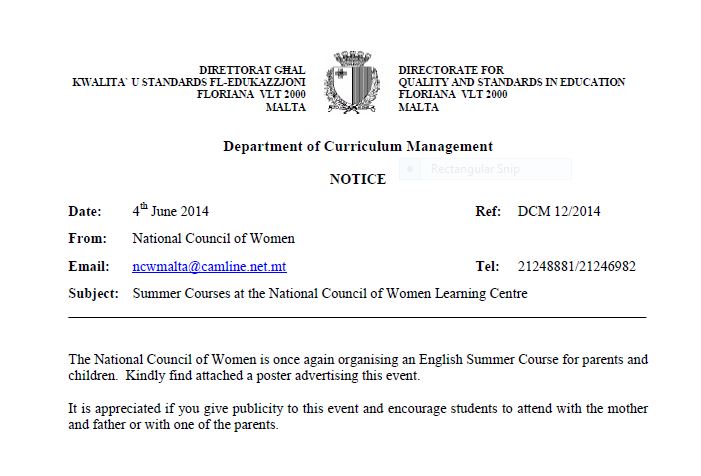

Parents of children at independent schools – possibly parents of children at all schools – have received the circular and poster shown here, from the Department for Curriculum Management at the government Directorate for Quality and Standards in Education.
It seeks to encourage parents and children to take a summer course in English which is organised by the National Council of Women.
I strongly suggest department personnel take the course themselves.
The grammar/syntax and general use of English in both circular and poster are appalling, including the disturbing use of ‘children THAT’ rather than ‘children WHO’.
As far as I can recall through personal experience, a mandatory part of the English-language curriculum was (is it still?) drumming into the heads of children that ‘that’ is for animals, plants and inanimate objects, while ‘who’ is for people.
And incidentally, even if we are to assume that the Department for Curriculum Management believes children to be interchangeable with inanimate objects, plants or animals, here’s betting that they haven’t a clue when to use THAT and when to use WHICH.
The use of THAT for people is a total uneducated Amerikanatathat I see spreading like wildfire among Maltese people who never learned British English (the real English and, so to speak, the industry standard) properly and who are instead learning a form of English from social media and from each other.
The PEOPLE THAT disease is now so deep and widespread that even young people with a thoroughly good education, who speak fluent and idiomatic British English, are falling victim to it.
29 Comments Comment
Leave a Comment
Swan, Practical English Usage-Page 473, Point 2:
http://languageandknowledge.files.wordpress.com/2011/12/practical-english-usage-by-michael-swan.pdf
‘That’ is fine. It is just less formal so completely acceptable on fora such as FB, not so on government announcements.
[Daphne – ‘International Students Edition’, Albona.]
I used to be a purist but the reality is that we are probably exposed to way more American English than British English thanks to the Internet so it’s a lost battle, really.
As a consolation of sorts, you may be interested to know that, until a couple of hundred years ago, the British accent used to be similar to today’s American accent and it is the former that changed while the latter mostly didn’t. So practice your drawl and prepare to return to the roots of the matter. Haha!
http://www.livescience.com/33652-americans-brits-accents.html
Exactly. Finally someone who can understand the subject without the prejudice of snobbery and South-Eastern bias that often predominates in their arguments.
English is more diverse in the confines of England’s territorial boundaries than it is outside them.
As Peritocracy rightly points out the various accents around the world encapsulate and conserve the accents of the time. It is no surprise that the various accents of New Zealand, Australia, South Africa, Namibia and Zimbabwe all share similarities as they received English around the same time. The same can be said for other languages too and the colonies.
You are right Albona, besides Swan is a bird and therefore an animal so I guess it’s OK to use that. (Please don’t take this seriously)
Another common error that makes me cringe is committed by many journalists with the use of ‘amount’ to refer to people when the correct word to use should be ‘number’.
[Daphne – Or this: “a handful of people”. How small must those people be?]
You’re so right.
They must be ‘Funsized’ like Kurt.
Yes, I hate ‘amount’ too – with a passion.
We were taught to use “amount” for anything which could not be counted, and ‘number’ for anything which could be counted.
And the same for “much” and “many”; “little” and “few”.
Amount, much and little are used with a singular noun; number, many and few with a plural noun.
But the standard of English in Malta has deteriorated rapidly. The mobile phone is making acceptable many errors in English that we were penalised for when we were at school.
[Daphne – I don’t think the standard of English in Malta has deteriorated. I remember a Malta in which the huge mass of people spoke and understood no English at all, a relatively small percentage spoke and understood it badly/fairly well, and a truly minuscule number of people spoke and wrote it perfectly. All we have now is a situation win which a large mass of people has acquired a poor knowledge of very basic English and uses it without embarrassment or any desire to improve, creating the perception that the standard has deteriorated. Actually, it has improved: from no English at all to really bad English. That’s a step up.]
Here’s a simple one.
It’s ‘kids that’ but ‘children who’.
As usual you can’t just admit you are wrong and let it lie.
I think you’ll find that in the new ‘British English’ edition Oxford, 2007, Point 494, Page 477, Third Edition, you will find the same point made.I have the book on my lap right now so there is no way you can deny this. In any case just because it is an international edition it is still British English. Did you assume they only sold the books in North London or did you not think that they might want to turn a profit by selling it outside the poshy snob-stronghold of that dialect that came to be known as English?
By the way, the very thing that made English so rich is its dynamism and ability to change with the times.
[Daphne – I routinely admit that I am wrong, but only when I am wrong. The fact is that I speak and write English idiomatically and have learnt it the same way. Instead of rummaging around in the rule books, a person is best off acquiring an ear for the language and for how different people use it, and of course, reading. Languages are not games of bridge or football: you do not check what is idiomatic/correct by referring constantly to the rule book (though that helps in many cases). If it sounds wrong and isn’t used by those who speak and write the ‘industry standard’ British English (or for that matter, even Canadian English or Irish English – Canada and Ireland have given the world some of the most glorious pieces of contemporary fiction) then don’t use it yourself. It’s wrong even if the grammar books tell you that it’s ‘technically right’ and makes your own use of the language sound inept. Take it from me: anybody who says or writes ‘people that’ automatically flicks a switch in the head of people who don’t. It’s a linguistic signifier.]
To me its snobbery and the wrong register in certain situations. I do understand your point; I am just asking you to move away from labelling Americanisms as some kind of inferior form. I too used to do this until I acknowledged that it was wrong, no less because some of the worst English is spoken in the home of English – the South East.
Also, using ‘that’ in the letter was wrong only because it was the wrong register. But to say that it is wrong in all situations is incorrect. In fact, in many circumstances — even I do not find it all that formal — using ‘who’ could be incorrect. Register is key as it is the difference between being socially intelligent, knowing how to vary your language according to the situation, or just being a snob i.e. socially inept.
And another Amerikanata which I really hate is the adding of the word ‘like’ in every sentence.
Could Facebook have a lot to do with this?
“Said”, as in “I said”, “he said”, “she said”, has almost completely vanished from normal everyday speech.
Replace every occurrence of the word “said” with “was like” and you’ll readily feel at home.
Like is more commonly used by Geordies.
I fear the Irish may originally be responsible for this although I stand to be corrected.
Yes, English standards have dropped all across the Anglophone world due to the moving away from traditional grammar and literature-based teaching. It still has further to drop.
I would suggest a ‘back to basics’ course, ideally using that famous and reliable grammar reference ‘First Aid in English’
I grew up on that. Not that anyone is not liable to make the occasional mistake, of course.
How truly appalling.
The Directorate for Quality Standards in Education should of at the very least employed someone with a QUALITY STANDARD IN ENGLISH to communicate with their target audience.
I wrote “should of” to make a point. Do you notice the word “of” taking on a meaning completely alien to what many of us are used to?
The SHOULD OF disease.
Should of. Shouldn’t of. They’re all over the place. That’s the whole planet, not just Malta. It’s worse than an epidemic.
And it’s all because people nowadays write without bothering first to read, and instead rely on the inaccurate hearing of the words “should’ve”.
Social media is our own worst enemy in this respect.
Writing good English is becoming odd.
On the letterhead of the Directorate for Quality and Standards in Education, no less:
‘The course is for duration of…’
‘…year of primary and … of Secondary…’
There’s a lot more, too.
‘People THAT’ is acutely irritating and I couldn’t agree more. America is the West’s largest purveyor of blockbuster films, novels, series, video games and other pop culture sensations. Its influence is not to be taken lightly.
And it sounds even more painful when people don’t pronounce ‘that’ correctly. The English ‘th’ is a digraph with two distinct sound (a voiced or a voiceless dental fricative) and is not equivalent to ‘d’.
The Maltese education system really need to drill this into students’ heads. Enough of ‘dat’, ‘dose’, ‘dee’, ‘dett’ (death) already.
I remember the way the nuns, back in the sixties, at St. Joseph taught us to pronounce ‘th’ was by reminding us to put our tongue between our teeth when saying ‘th’ words.
While we are on the subject of pet peeves of the Americain English variety, I have to share one that I hear constantly here, in America, and that drives me crazy. It is the incorrect use of ‘good’ as an adverb as in, “You did good” instead of,”You did well.”
Another frequent misuse is when someone is asked,”How are you doing?” A common reply is,” I’m doing good.”
I have made sure that my children know that ‘good’ is an adjective and ‘well’ an adverb.
Did you get the “invite”?
The Americans and the English are two democratic nations separated by a common language.
Nice one Francis, I like that
Wasn’t it Churchill who said that?
To be expected of course from such a stickler for the King’s English.
No. It is attributed to George Bernard Shaw.
It’s a shame really because my summer English language skills are perfect; all I need is a brush-up of my winter English language competence.
“The course if for duration of 10 weeks” – What on earth is that??
The course lasts 10 weeks
or
The duration of the course is 10 weeks
or
Course duration : 10 weeks
In American English ‘who’ is preferred in formal writing.
Most people who learn Portuguese or Spanish don’t learn it because they are interested in Spain or Portugual.
Most of them are interested in Latin America. Likewise the Chinese, the Arabs, the Japanese, the South Americans, and even those living in former British colonies don’t learn English because they are interested in the UK.
English is important because of the US. British English is not the most important standard nowadays.
Regarding ‘purity’ this is not a very compelling argument. Both standards have changed.