
PANAMAGATE: the point is the top-level secrecy, not the blacklisting
The Labour Party/government is at great pains to create confusion around the blacklisting of Panama as a financial services jurisdiction, by the European Commission.
This is typical. When on a rout, and even when their star is in the ascendant and they needn’t bother, they deliberately miss the point and rely on the fact that lots of people will walk down their yellow brick road of reasoning because they are not quite sure what to think.
So here it is, in black on white. The point is not the blacklisting but the high level of secrecy in Panama’s financial services jurisdiction which is the reason for the blacklisting in the first place. That secrecy cannot be breached, not even by other states armed with court orders and police warrants.
The fact that we have got to know about Konrad Mizzi’s and Keith Schembri’s companies in Panama is only by the most remarkable series of coincidences that begin to the realms of thriller fiction. And even in thriller fiction, they would have been dismissed as absurd. Had it not been for an extraordinary, and I mean, extraordinary, chain of events over several years, that led to this fortuitous discovery and consequent revelation, Konrad Mizzi and Keith Schembri, and therefore the Prime Minister, would have been left unmolested by public outrage because we would never, and I mean never, have been able to find out about them.
So bear that in mind. It’s by the most astounding series of incredible luck and fortuitous coincidences that they have been discovered, because otherwise, they would have got away with it, and would have got away too with the corruption for which those asset-concealing vehicles are clearly intended.
Panama’s blacklisting only indicates its extreme secrecy and nothing else. It indicates that those who choose that jurisdiction are prioritising the highest level of secrecy possible (which, through the aforementioned incredible series of events, blew up in their faces).
The point here is not the blacklisting, but the secrecy, and the illicit intentions to which that secrecy points. The British Virgin Islands are not blacklisted, but if Konrad Mizzi had set up a company there, just as Keith Schembri – from whom he said he takes advice in these matters – has set up more than one there over the years, it would be just as bad. The British Virgin Islands is a top-secret jurisdiction too. The only reason it is not blacklisted by the European Union is because it has signed a cooperation agreement with the bloc.
That agreement, however, remains restricted and continues to allow for total secrecy. The EU tolerates that secrecy because in exchange, the British Virgin Islands taxes the secret money held in its jurisdiction at 35% and passes 75% of that on to the owner’s member state. If the owners don’t consent to the tax, then their details are passed on to the EU member state where they are domiciled for tax purposes, to be dealt with there.
So Konrad Mizzi’s actions, if he had set up his company in non-blacklisted BVI, would have been just as highly suspect, because the levels of secrecy are the same. The only difference is the tax requirement in return for that secrecy. The bottom line is that Mizzi set up his company in Panama not because Panama is more secret than the British Virgin Islands, because it isn’t. He went to Panama because the British Virgin Islands now levies a mandatory compulsory tax requirement of 35% to maintain that secrecy, and Panama does not.
The bottom line is that both blacklisted Panama and non-blacklisted BVI are just as secrecy. But in one you have to pay 35% tax now and in the other, you don’t. Konrad Mizzi chose blacklisted Panama over non-blacklisted BVI because of greed. Both jurisdictions offered him total secrecy.
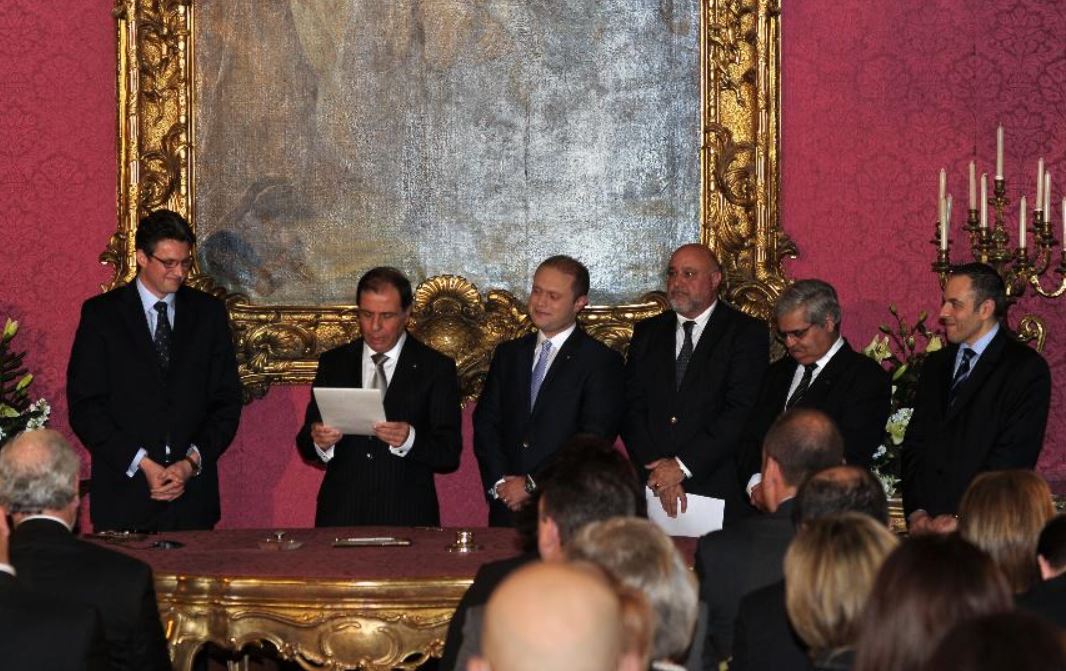
Konrad Mizzi, Joseph Muscat and Keith Schembri (why is he there?) at Mizzi’s swearing-in as Minister for Energy.