
Which bits of this did Nakita plagiarise, do you think?
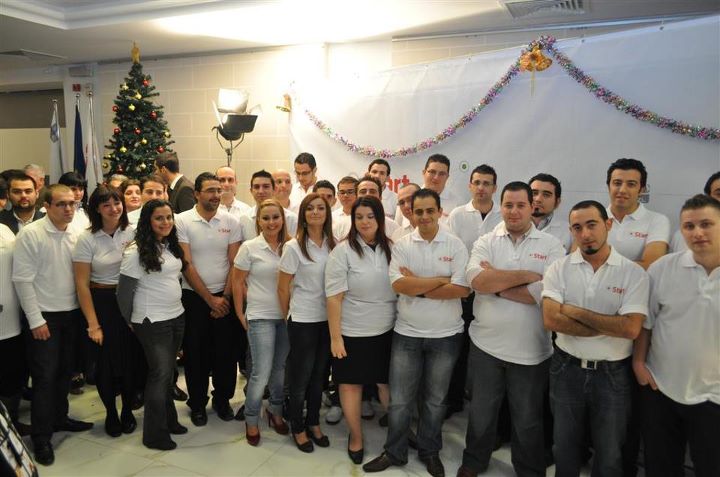
Christmas in the grotto: the elves line up to have their picture taken
Down below you’ll find Nakita Zammit Alamango, aka Nikita Alamango, recruiting more elves for Labour’s internet-comments factory, as time is pressing and the ones they’ve got now have sore thumbs and index fingers.
START is Elve Central, an induction programme run by Forum Zghazagh Laburisti.
“The potential so many youths have nowadays is incredible,” Nakita tells us. No, my love, the potential of young people remains entirely unchanged, because it is genetic.
It is the opportunities which are different, and those opportunities have created a different outlook, at least in some people. Most of the young Labour people from among whom START must perforce recruit its elves are in fact only semi-literate, as the most cursory glance at the internet will reveal.
They might have all the ideas Nakita says they do, but they had better learn how to put them into writing in comprehensible sentences before they even think of changing the world, or even just Malta.
Nakita is one such sad example. At the age of 22 or 23, her thought-formation and writing skills are those of somebody 10 years younger. And here I am generous, because I seem to recall that at the age of 12 I could put commas in the proper place, work out the correct tense for a verb, and even use some words that were not in Peter and Jane Ladybird books.
Why, I even knew what proper nouns are, because we’d had them drilled into our heads at around the age of nine. Paris, London, Nakita and Cyrus Engerer are proper nouns, madam. Public service and local councils are not.
“Change your live”, indeed.
And please take note of this, Nakita and others, once and for all: ‘youths’ does not mean young people. It specifically means young men. When you read an article in a British newspaper about some man stabbed by a gang of youths, you know for a fact that they were all men. Otherwise, the newspaper would have said that the man had been set upon by a gang of young people or teenagers.
Ah yes, teenagers. ‘Youths’ are generally in their teens. At a push, you might still be a youth in your early 20s, but it’s unlikely. At that stage, a British newspaper would call you a man. As for youths in their 30s – and I can see at least one in this photograph – forget it. Those who are still in a youth programme at 30+ are suffering a major career setback, to say nothing of their perspective being skewed.
————–
But where should I Start?
Posted on December 12, 2011 Blog by Nikita Alamango
How many times have you heard the question “But where should I start?”
For the past years, since I have joined PL and FŻL in our daily voluntary work, I have met people out and about who are preoccupied by the same thing: How to get involved and how to help out?
I remember the same questions running at the back of my mind when I had just started my 6th form years at Junior College. Many times, even in my case, it all depends on meeting the right person at the right time, during the right circumstances. One person can change your live .
However, this shouldn’t be the case. What happens if this person never comes along?
This is the reason behind FŻL’s START’s campaign. Now all the youths out there who want to get involved, who want to start to build their career in politics or Public Service have a platform, provided by the Labour Party. And what’s a better starting point than Local Council elections.
The potential so many youths have nowadays is incredible. I am amazed at the amount of youths I meet, who are filled with so many new creative thoughts and ideas. It will be a total waste of talent if these youths don’t find the support and helping hand they need.
We want to hear from you – your ideas, your thoughts and your proposals.
As youths, we have to come up with the ground-breaking ideas for today and tomorrow’s future of our country.
Pooling our ideas together can make a difference.
34 Comments Comment
Reply to Matti J Click here to cancel reply
Having been visited by the ghost of Christmas past, who warned me about slagging off so many people, I feel I must put in a good word for our fine zaghzagh involved in political youth programmes.
I wouldn’t touch a godawful “youth forum” with a barge-pole. Not now, not back when I was still a youth. But you have to understand the sheer emptiness which is life in Malta.
Boredom isn’t quite the word. It’s like a NASA sensory deprivation exercise which lasts your whole life.
So some of our young people seek fulfilment in politics. And who can blame them?
Politics is just about the only thing that gets some energy injected into it on this barren rock. I’m not saying that anything remotely intelligent ever comes out of it, but they find a fulfilment of sorts. They feel useful. And the chance to get up close and personal with an intern, like that chappie from Ides of March, is not to be scoffed at.
At least it keeps one occupied until one gets down to the serious business of tiling the bathroom and marrying Ritienne. Before a brood of little shrilling Jaydens comes along.
‘Politics or public service’
It’s always the same with these people, nothing beyond the centrality of bipolar politics and a self generating public service regime.
Very sad.
Sad indeed. Entrepreneurship is a dirty word in socialistic/communistic thinking.
The word youths or youth dos not necessarily exclude females. Besides there is no definite age limit for youths. Youth can include teenagers as well as young adults.
The concept of youths is I think quite a recent phenomenon, the result of the development of a youth culture.
http://www.thefreedictionary.com/Youth
[Daphne – Ah, David again. Yes, David, in idiomatic English, the word ‘youths’ means young men, not young women. Take it from me, and stop going to your ‘free dictionary’, which gives you the Globish definition, not the idiomatic British English definition. Christ, how tedious you can be.]
Oxford Dictionary entry
Before I post it, I think the error most people make is that they cannot distinguish between the concrete youth (a young man / young men) and the abstract youth (the pre-adult age)
“The potential that so many youths has” would imply young men, since many is quantifiable. The abstract is not quantifiable. So the usage is incorrect.
Now: the non-‘Globish’ entry
noun (plural youths /juːðz/)
1 [in singular] the period between childhood and adult age:
he had been a keen sportsman in his youth
[mass noun] the qualities of vigour, freshness, or immaturity as associated with being young:
she imagined her youth and beauty fading
an early stage in the development of something:
this publishing sector is no longer in its youth
2a young man:
he was attacked by a gang of youths
[treated as singular or plural] young people considered as a group:
black youth has experienced high levels of racial discrimination
[as modifier]:
youth culture
I think you’ll find that the United Nations defines a youth as anyone between the ages of 15 and 24.
http://www.unesco.org/new/en/social-and-human-sciences/themes/social-transformations/youth/
[Daphne – I have to be so patient here. I’ll just repeat it once more. Globish is not British English. Here in Malta we speak – or are supposed to – British English and not Globish. Globish is an international form of English for people who are constrained to learn it late in life without earlier natural exposure to the language. In IDIOMATIC BRITISH ENGLISH, a youth is not a young woman, but only a young man. I just cannot, for the life of me, understand the persistence of so many Maltese people in adopting Globish terms, expressions and meanings, which puts them at a huge disadvantage by making them sound like non-native speakers. I am glad to see, though that even the UN agrees that people in their late 20s, still less their 30s, can be described as youths. The Labour Party should take note.]
Dear Daphne,
That definition of youth is archaic. I am of the impression that even in Britain, the more modern definition of the word ‘youth’ is used. Perhaps this may be for the sake of political correctness, but it is used nonetheless.
Furthermore, British English is one form of English. It is very naive to assume that everyone should speak it, or that it is the correct form of English. Otherwise this would severely undermine the use of English as a global lingua franca.This definition of youth is only true for one type of English (i.e. Brit. English in this case). So how can you assume that it is the -best- and/or -true- use of the word?
[Daphne – Archaic? Hardly. Language is not a matter of opinion, Patrick. Who was it who said that Xarabank caused the Maltese malaise of refusing to acknowledge that there is such a thing as fact and that where opinion is concerned, some opinions are expert and more valid than others? I am losing patience with people whose knowledge of the language is as a third or even fourth coming in here and insisting that their way is the right way, because ‘in their opinion’ they are right. British English is the ‘ultimate’ expression of the language because, in case the name hasn’t given you enough of a clue, it is the real thing. If you choose to learn Spanish, which are you going to opt for: the Spanish spoken in Spain or the Spanish spoken in South America? And that is quite apart from the fact that it is British English which is Malta’s official language, not Australian English or American English, and certainly not the Globish that so many of you now seem to be opting for, presumably because you really, really want to sound like somebody who grew up in Slovakia.]
Your condescending tone is completely unnecessary. Especially when you’re trying to talk about a subject in which you don’t know much about.
[Daphne – The condescending tone was yours, Patrick, and it was reciprocated. You are using the same tone again here. Read your second sentence again: you are definitely not English as you claim, and if you teach TEFL courses, your other claim, you should be fired.]
The English language is not governed by opinion, it is governed by usage.
[Daphne – You mean ‘English’, not ‘the English language’. Usage becomes established over time, turning into ‘the rules’. There remains at all times a correct way to write and speak, and various incorrect ways of doing so, which are ‘accepted’ for some purposes but still regarded as inferior for other purposes.]
There is no equivalent body such as the Real Academia Española or the Académie française for English. Dictionaries record usage, and do not prescribe it. Why do you think the range of words in the Oxford English Dictionary includes American English ones, Australian ones, etc.?
[Daphne – Because it is a dictionary, Patrick. You will note, however, that newscasters for the BBC World Service are required to have a particular accent and to enunciate in a highly specific way, and that the words and sentence construction they use are not determined by usage but by the preferred usage of their sovereign. That this is the form of English, and the accent, which Britain, through its state broadcaster, wishes to broadcast to the world (while not doing the same at home) tells you that this is considered, by Britain itself, to be the ‘ultimate standard’, the obvious inference being that all other forms are inferior. When the BBC broadcasts that kind of English (and that accent) to the world, it is a branding exercise, pure and simple.]
British English is not the ‘ultimate’ form of English. What does that even mean? In addition British English is spoken by comparatively few people around the globe.There are scores of variations of British English alone, each with their own intrinsic vocabulary.
[Daphne – No, you are definitely not English. ‘The ultimate expression’ of the language means exactly that. If you do not know what it means, you shouldn’t be teaching it. Carry on promoting Globish.]
All forms of English are equally valid, and it is up to the individual to decide which one they want to use. Therefore the Spanish question is irrelevant. In fact, I have a friend learned Spanish in Colombia, rather than Spain (and they were European).
I have no idea what you mean by that Xarabank comment. I do not watch the vile show.
[Daphne – You have never watched it, and yet you are confident it is vile.]
You mention expert opinions… Are -you- an expert about the English language, Daphne?
Oh and FYI this is a quote from Malta’s constitution:
“The Maltese and the English languages…sha l l be the official languages of Malta and the Administration may for all official purposes use any such languages.”
I don’t see anything about British English.
[Daphne – It is implicit, Patrick. The Constitution would never specify ‘British English’, because the formal name of the language is English, in South Africa, Australia, Canada and the United States as it is in Malta. The only reason English is one of Malta’s official languages is because Malta was part of the British Empire, and when that Constitution was written, Malta was not yet a republic. The Constitution itself is written in British English.]
“Who was it who said that Xarabank caused the Maltese malaise of refusing to acknowledge that there is such a thing as fact”
That was H. P. Baxxter, right here on this blog.
And I wouldn’t blame Xarabank alone. John Bundy on Affari Taghna’s doing his bit. Do you remember that programme featuring Libyan people, shortly after Libya erupted? John Bundy made a point of saying that he condemns ALL forms of violence, by implication, even those who fought back.
When did I ever claim to be English? Or explicitly state that I teach TEFL courses? Why am I even discussing this topic with someone who clearly can’t read English?
[Daphne – You claimed to be/do both, Patrick. Whatever your problem is, take it elsewhere. I am not interested in engaging any further with somebody whose problem is obviously personal and has nothing to do with the word ‘youth’, while he, or for all I know, she, remains anonymous.]
You make such sweeping statements, without sources to back them up, and I seriously doubt their legitimacy.
However, if you must know, I did actually take a TEFL course. If the teacher was worth their salt, which mine was, they’d tell you that it didn’t really matter which type of English you taught. We even had a few Americans in the course, do you think they ended up teaching British English? The type of English they speak on BBC is spoken by less than 5% of the British population. The purpose of language is to be understood. That is not to say that you should speak it incorrectly, but regional variations exist of English. Therefore it is incorrect to say the British English is the ‘correct’ form of English.
Therefore, would you call it the -right- English? I would assume that the journalists on BBC come from a certain socio-economic background and/or attended certain educational institutions. Therefore this is the likely reason why they speak in this way, rather than getting a memo from the Queen or whatever nonsense you say. If you can find a source for your claim, well and good. But I suggest you refrain from making such sweeping statements (or at least, making them sound like they are not your opinion, but fact). Have you ever thought that they speak in this way because it is simply phonetically pleasing? I think you’ll find that anchors in the US seem to have their own way of speaking English. Do you think this is because they want to ‘export’ their version of English? Unlikely.
In regards to Xarabank, yes I have watched it. And I do not watch it because I do not like it. Stop being childish and pedantic.
In regards to the constitution, and legislation in general, you’ll find it is very carefully worded. It has to be. You can’t say that “oh but it implies this because it was written then” or something like that. It is what it is because it has been written in that way. If it wasn’t they would have changed the wording.
Honestly, can you realistically imagine using these arguments against a well-respected American linguist? There would be much raising of brows.
You won’t reply because you know I’m right.
I have read my responses very carefully and nowhere did I say I’m British or, prior to my last message, that I was an EFL teacher.
My ‘problem’ as you call it, is not personal. I do not even frequent your blog. However, I found it most ironic that when correcting someone you were, in fact (or, at the very least, in my opinion), wrong.
Yes, I remain anonymous. Is there a problem with that? If you really want to know my name I could easily give it to you, but not here in this blog.
But it would be to no avail, as I am done discussing this.
Yes, I’m sure they all seek inspiration in Bernstein and Luxemburg.
Beautiful, well crafted and truly inspirational. While also being a stern warning to electricians everywhere.
Also, the space before the punctuation mark allows you to fully savour the gravitas within.
One person can change your live .
Indeed.
I don’t think she copied, this time. Phrases like “the amount of youths”, “during the right circumstances” and “what’s a better startng point” all bear the hallmark of genuine Elvenspeak.
I agree with you perfectly, Antoine. Gillian Tett, for instance, would not have used any of those expressions or made those mistakes.
Why do the three men at the front have their arms crossed? Am I in for a beating?
Look, John. Labour is training its “youths” to keep their hands safely away from business. If Labour’s hands are not kept crossed, they will be in the businessmen’s pockets.
My thoughts exactly. Maybe they’re bored.
I just love the condescending way Nakita speaks about her ‘youths’, as though she’s Oprah Winfrey with years of experience and successes in the bag, giving advice to young budding politicians. Lucky them.
Would that be ‘yutes’ in spoken manglish?
http://www.youtube.com/watch?v=YpNgONH2ncI
“One person can change your live” – is it so hard to spell it with an f? LSE my foot.
[Daphne – She lied about that. Imagine lying on Facebook about being at a university like that, and in her position, too. What next, Alex Saliba posting a line on his info page, telling us that he’s at Yale?]
She’s still making that claim here:
http://standupmalta.wordpress.com/bloggers/nikita-alamango/
and here too, but she gets the name wrong:
http://startmalta.wordpress.com/bloggers/nikita-alamango/
Hmmm, maybe she studied at St. Martin’s Institute of IT, which is a ‘licensed teaching affiliate of London International Programmes”. Some idiots pretend that it is thus a subsidiary of LSE or something – I’ve seen others on Facebook claim that they studied at LSE when really they just went to St. Martin’s.
Chavtastic.
Ikolli nghid ghamilt ricerka hazina. Jekk ticcekja sew tinduna kif dawn iz-zghazagh mhux illitterati anzi….have a look and you’ll be surprised!
http://www.guardian.co.uk/uk/2011/sep/07/student-killed-after-conker-row
Byline: “Steven Grisales was stabbed after asking youths to stop throwing conkers at him”
The “youths” in question were: “a 15-year-old boy”, “a 19-year-old man”, and “a 16-year-old girl”.
If you’d like, I could find you a thousand references in ‘British newspapers’, to the word youth being used to refer to males and females of the 15-to-25 age group.
“Youth employement” and “disenfranchised youth” immediately spring to mind as media buzz-terms that would make absolutely no sense if your ‘idiomatic’ definition of “youth” were valid, or to give the benefit of the doubt, the only valid definition.
[Daphne – Youth in youth unemployment is a generic noun, Alex. Look it up. It is not the same word as ‘youth’ as in young man, even though it looks and sounds the same.]
Dear Daphne,
May I ask why the malicious delight in slagging someone just because they have failed to perform a minor spell-check? I’m pretty certain that in your own “youth” you must have accidentally made a couple of spelling mistakes (unless you were little Miss Perfect in the flesh since the age of 4). I will not care to blast you by claiming that you had a malformed childhood hence your spiteful blogs, but I will say that you seem to have no limits on how low you’ll go.
[Daphne – Minor spell-check? The problems in that piece of writing will never be corrected by a computer’s spell-checker. No, I did not make spelling mistakes. I had very strict English-language teachers and I also read voraciously from, as it happens, the age of four. Nikita is 22. At 25 I was The Sunday Times’s first named columnist (and first woman journalist, excepting its late owner-editor). My spelling and punctuation were no different to what they are today. My childhood was actually a great deal of fun, full of the special advantages (not all of which cost money or took effort) which gave me many of those other advantages I have today, including the ability to think for myself and have insight into situations. I suppose I was lucky to have parents who were not ‘typically Maltese’ in outlook. I tried to bring up my children the same way. That’s why the one who is Nakita’s exact age is, at 22, in the second year of a doctoral programme at the London School of Economics (having already graduated with a first from the University of Malta and then with distinction from the LSE), while Nakita has instead been reduced to LYING about being in an undergraduate programme there. I enjoy repeating this to rub your noses in it.]
That being said, I will not deny your right to say whatever you want, even though in normal societal terms it is a tad bit over the top.
As for “youths” stands for young people and NOT just men (yes, I dare to correct you). Your definition of “youths” as being just males is wrong because you are associating with British slang (of which quite frankly speaking, you seem to know a disturbing amount).
[Daphne – British idiom, Mr Tony, not British slang. The Labour Party speaks Globish. I speak British English. So do lots of those ABC1 PN voters you are trying to entice to your lair. You should know – this is free advice here – that when you talk about ‘youths’, people like me give a sharp intake of breath through their teeth. Talking about youths has roughly the same effect on us as wearing a mustard shirt with a black tie and a brown jacket. As for your not denying my right to say what I wish, I wouldn’t bet on it, given that you clearly supported the governments which denied that very right for 16 years.]
When referring to “youths” in general as Nikita was (I daresay either your spellchecker had malfunctioned or your sight is going for I could have sworn you kept on addressing her as Nakita…), one is talking about young people in general as it is an uncountable noun (seeing as you seem to pride yourself on being technical and a genius in British English), and this is backed up by Macmillan Dictionary (a proper and widely-respected British dictionary at that):
http://www.macmillandictionary.com/dictionary/british/youth
[Daphne – Her real name is Nakita. Look it up. If she wishes to fake even her name, then so be it. I just love the way people like you come in here giving me lessons in English. Surely you should have even the little intelligence it takes to work out that I am likely to know the meaning of ‘youth’ and how it is used, and what’s more, without recourse to the dictionary. ‘Youth’ can be either a young man or a generic noun (as in ‘youth unemployment’) in which it refers to age and not to gender, so taking in both men and women. But ‘youths’, the plural of ‘youth’, means men.]
That being said Daphne, I do love your wit…. the problem is how you use it that I have reservations.
Cheerio and good evening to yourself. Don’t forget: play nice.
[Daphne – If by playing nice, you mean having compassion for morons, then you’ll be disappointed. As long as those morons are gearing up to run the show and tell me how I’m going to live my life, as long as they’re running the show and telling me how to live my life, they’re going to find me there with a gun. Metaphorically speaking, of course. I have to specify this for people who speak Globish.]
Post note:
You may be right, you may be wrong. No disputes about that as we agree to disagree.
However, coming as an EFL teacher I have to say that you are still wrong on “youths” nowadays as they still refer to them as both sexes.
[Daphne – Tony, EFL teachers teach Globish, not British English. I should know, because I used to be one when I was 21. In British English, a youth is a young man. When you are teaching your students, you would be well advised to make it clear that if a British (or British-English-speaking) person talks about the youth in that corner, and you look up and see that in the corner there are a young man and a young woman, you should know that he/she is talking about the man, so you shouldn’t ask ‘Which one?’ because he/she will look at you as though you’re blind or nuts and say ‘But there’s only one.’ It is part of your job to know that there are different forms of English and that Globish, the world standard, can be very different to British English. It is also part of your job to know that speakers of British English ‘weed out’ speakers of Globish precisely by noticing these idiosyncracies, and so you should make a point of knowing exactly what distinguishes speakers of British English from speakers of Globish, so that you can in turn pass on this knowledge, given that British English is perceived as superior to Globish (which it is for reasons that should be obvious). I say this in good faith and not as a point-scoring exercise, in which I am not interested.]
Last by not least, you really ought to be careful who you attempt to paint as a Labourist, as I am not, and regarding free speech I certainly haven’t “clearly supported the governments which denied that very right for 16 years” purely because I’ve no interest in Maltese politics.
[Daphne – If you live and work in Malta, regardless of whether you are Maltese or not, having no interest in Maltese politics is not something of which you should be proud.]
Oh and I’m English at that. Belittling or seeming to possess superior intelligence is a bit childish, don’t you reckon?
Have a nice day!
[Daphne – Yes, of course you’re English. Anonymous people can claim to be whoever and whatever they wish. Your comments, however, reveal otherwise, including your manifest insecurity in perceiving a simple discussion about a word as me belittling you or proving that I have superior intelligence. If this is what it’s all about, rather than a discussion of the word ‘youth’, then you are just another person with a chip.]
Somebody should be charitable and tell those ‘youths’ that even the Great Leader has shaved off his goatee.
And what’s with the white t-shirts and slouching?
The picture screams mediocre.
I bet all of your lesbian readers, after reading this post, will start looking for the Fountain of Youth to turn into beefy young males.
Is my comment still awaiting moderation? :)
It’s just that you seem to have already sorted out a number of comments posted after mine. A number of less-reasoned comments, one hastens to add.
[Daphne – If it tells you that it’s still awaiting moderation, then it’s still awaiting moderation. Comments are moderated on a last in, first out basis – because that’s how they show up on the screen. Kindly don’t be tedious.]
“Disturbing amount”, you say?
Indeed.
Every Maltese is expected to know a “disturbing amount” of British English, because it’s our official language. Much to your chagrin, no doubt.
This should convince even the most stubborn:
http://www.merriam-webster.com/dictionary/youth
There is an interesting comment at the bottom of page, which I am pasting here:
Jesse M. Mumba · Acting Medical Officer-in-Charge at Ministry of Health of Zambia
Our National TV keeps showing men older than 35 yrs of age posing as youth of the political parties. I was interested in know the age limits applicable to the word. turns out my people are taking too long to mature hence our political leaders have to be grand father age.
How old is Joseph exactly?
‘Balzan Youths’ are the Best