
This is just so typical, isn’t it, despite the myths we concoct and repeat about ourselves
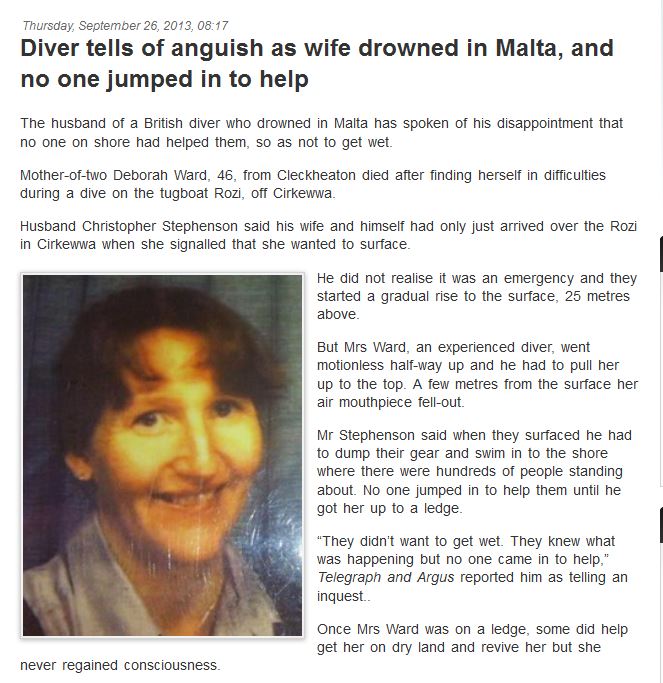
A man tries to get his unconscious, dying wife to shore at Cirkewwa, struggling to dump the diving gear they were both wearing, and “hundreds of people standing about” don’t jump in to help – not one of them – because they don’t want to inconvenience themselves by getting cold and wet.
Times of Malta reports on a story from a British regional newspaper:
Mr Stephenson said when they surfaced he had to dump their gear and swim in to the shore where there were hundreds of people standing about. No one jumped in to help them until he got her up to a ledge.
“They didn’t want to get wet. They knew what was happening but no one came in to help,” Telegraph and Argus reported him as telling an inquest..
Once Mrs Ward was on a ledge, some did help get her on dry land and revive her but she never regained consciousness.
9 Comments Comment
Leave a Comment
It was just their bad luck that there were hundreds of people. Literally. They would have stood a better chance if there were four or five people on shore.
https://en.wikipedia.org/wiki/Bystander_effect
Mrs Caruana Galizia, your comments are extremely unfair. Kindly allow me to elaborate.
I have been diving for over 20 years and I dive Cirkewwa practically every week. I was not present when this unfortunate accident occurred, but I have been present when there were other accidents.
Most of those present would have been foreigners. On any given day, hundreds of divers descend on Cirkewwa, which is suitable for divers of any level of experience. The bulk of these divers are always tourists. There are a handful of local guides/instructors, but by and large, even dive centre staff tend to be foreign. There are usually more Maltese on weekends, but 31 October 2012 was a Wednesday.
Dive Centre staff are all highly trained in diver rescue. Whenever I have witnessed a dive emergency, it has always been all hands on deck to help the casualty, as well as anyone accompanying them. I have seen trucks being physically lifted, because their owners would be underwater, oblivious to the fact that there was an emergency, to clear a path for a helicopter to land. Indeed, whenever I run rescue diver training, I make sure that I have people on shore, and in the water, to let others know that a simulation is going on, so that fellow divers do not go into emergency mode.
What the times is reporting is the perception of somebody who has gone through a trauma. I will never believe that people did not help “because they did not want to get wet”. They were there to get wet in the first place. I am sure that the truth is significantly different to what is reported.
So as you were not present on this particular occasion, these are all suppositions of what you want to have happened and not what actually happened as reported in the Telegraph & Argus and then Times of Malta.
My father was recently walking down a street in Valletta when he fell flat on his face and not one of the shop owners / sales staff standing outside their shops to smoke their cigarettes, and who noticed my injured father, went out to help him.
He managed to get up on his own, went into Wembley’s Store to buy some water, on his own, and managed to get on an Arriva bus, on his own. He collapsed as soon as he got home.
Nobody cared. Of course, I believe this Englishman’s story.
I also find this report a bit hard to believe. We’ve had people trying to form a human chain in rough seas trying to help two French people (a man and his daughter who unfortunately both died).
I too think that this is a man suffering from trauma that’s giving this account.
But the fact that nobody helped him, just like nobody helped my injured father, still remains.
Nobody helped them. It is useless trying to find ways to excuse the feelings of the people at shore.
If the Englishman showed signs of distress and still nobody noticed them, then this country and its people must be really stupid. Should this incident surprise us?
Usually the ones who jump in end up dead as well. One has to see the weather conditions and the situation. If the man was coping well then there was no need to endanger others.
Compare with: ‘Holidaymakers made human chain to save migrants in Sicily.’
http://digitaljournal.com/article/356669#ixzz2g0GPeHDH
Yes, we deserve Joseph Muscat.
To all of you who commented in favour of the widower Mr Stephenson, you were all taken for a ride by a person involved in his wife’s demise.
He was the only person diving with her and he initiated the rescue underwater. Only he knows what exactly happened .
Shifting the blame of the diving fatality on the ” Maltese onlookers who did not want to get themselves wet” is not only unfair but very far from the truth.
Do not believe everything people say. Sometimes, either to hide one’s guilt or for some other reason, the truth is twisted.
To Il Bacchino Malato Di Caravaggio che cazzo dici. If you were not there to see your father’s mishap in Valletta please take what he recounted to you with a pinch of salt. Fathers sometimes exaggerate stories especially ………..
Daphne although I admire you immensely, your writing actually, as i never met you, you swallowed the bait,hook,line and sinker on this one. I agree with your reasoning and intuition for 95% of the times but not now.
As a person involved in the SCUBA diving industry for the past thirty years I got to know from eyewitness for a fact that many divers jumped in to help the couple and brought them to shore. The woman was still alive but succumbed later to her severe injuries. Barotrauma is a pressure related injury and there are many types, some very common to diving related incidents. The late Mrs Ward suffered from CAGE ( cerebral, arterial, gas embolism)the worst type of barotrauma to treat, besides having spent part of her ascent without a mouthpiece inhaling water during her husband’s attempt to rescue her, as stated by her husband himself,did not help matters.
According to eyewitness Mr Stephenson surfaced far from shore and seemed to the divers and bystanders ashore as a diver towing his tired buddy, a common occurrence seen regularly at such dive sites.
A diver in distress must wave his arms and splash and call sometimes using a whistle or other means of attracting attention, which Mr Stephenson did not do.
Unfortunately accidents happen but most can be avoided with proper training and diving to your limits.